Lebanon launches the first electric train... Rasamny: Developing shared transportation constitutes an economic and social priority
21:08 · 09 October 2026
13 min read
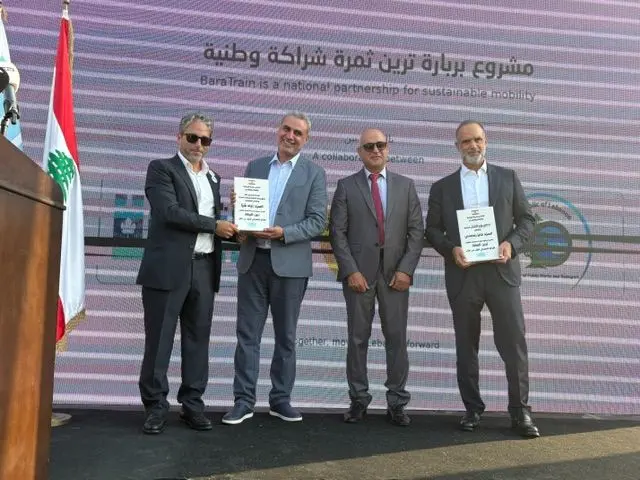
The General Corporation for Railways and Combined Transport and the municipality of Barbara in the Jbeil district launched the first electric train in Lebanon, BARATRAIN, under the patronage of the Minister of Public Works and Transport, Fayez Rasamny, during a ceremony held near the port in the town, attended by: Minister of Tourism Laura Khazen, MPs Ziad Al-Hawat and Neama Ephrem, Director General of the Department of Railways and Combined Transport, Engineer Ziad Chia, Director General of the Green Project, Engineer Raymond Al-Khoury, Representative of the Director General of Civil Defense, Brigadier General Imad Khraish, Chairman. The Regional Office for Civil Defense in the Jbeil District is authorized by Makoul Bou Younis, the Governor of the North, Iman Al-Rafii, the Consul Karam Doumit, the Mayor of Aley Badr Zeidan and Jbeil, Nathalie Marai Al-Khoury, the Commander of the Mount Lebanon District in the Internal Security Forces, Brigadier General Abdo Khalil, the Mayor George Moufarrej, members of the Municipal Council, and a number of mayors, the Mayor of the town, Michel Mikhael, the President of the Kataeb Province of Jbeil, Halim Al-Hajj, the Jbeil District Coordinator in the “Lebanese Forces” Party, Dr. Savio Barakat, Vice President of the American University of Technology AUT, Dr. Mersal Hanin, Vice President of the Cultural Council in Jbeil District, Dr. Nofal Nofal, Engineer Jean Gibran, in addition to the owners of the companies contributing to the project, the designers and implementers of “Barbara Tran,” and a crowd of invitees and events.
Abi Haider
After the national anthem, the media host of the celebration, Petra Abi Haidar, gave a speech in which she said: “For many years, the railway has existed in Lebanon, but the train has been absent. Entire generations have grown up hearing about the train from their families and grandparents, and they see the railways still existing in the towns, but a large part of them has become neglected, and in many areas they have been encroached upon. Today, from Barbara, we see a small attempt, but it is enough to change the picture.”
She added: “The BaraTrain is an electric train, made in Lebanon, that will run on about three and a half kilometers of old railway, from Barbara, passing through Kfarkada and Faghal, all the way to the Madfoon Bridge, on a tourist trip between the sea and nature. It will be the beginning of a tourism and awareness project, and the trips will be designated for schoolchildren. During the weekend and the summer, they will expand to become daily and free.”
She pointed out that "this step may open the door to similar steps in other Lebanese regions," noting that "the train issue is being strongly discussed at the state level, and one of the most prominent projects being worked on is reactivating the railway line in the north and linking it to the port of Tripoli towards Aboudia, all the way to the Syrian interior, with the aim of restoring the role of railways in transport and trade and linking Lebanon again to Syria and from there to the region."
Released
Mufarrej pointed out that “the Barbara train is part of the Barbara Tracks project that aims to educate the new generation on the importance of the train, the world’s premier means of transporting tourists and goods,” and said: “The municipality will organize trips for school and university students to live this unique experience. Riding the train is free and can accommodate about 42 passengers. It runs at a speed of 15 kilometers per hour and is proudly manufactured in Lebanon. It also runs on renewable energy, and most importantly, it runs on the railway they built.” Grandparents since 1895.
He added: "This experience made me realize the greatness of those who built the railway, the precise engineering and knowledge they had, and how small we are in front of the giants who came before us. It is true that Barbara Tran walked 3.5 kilometers long, but I have hope that this experience will expand and be adopted by a number of neighboring municipalities, and we are ready to provide all support for the success of this vital project and the political and economic movement it represents."
He continued: "There is no fear, with the private sector standing by our side, and this indicates that nothing is impossible. What is important is that we build trust and be honest and committed to our pledge. This is not the end, but the beginning, and we need a trial period to identify all the shortcomings and things that must be worked on to improve the train. There will be a second and third phase, and we are listening ears to all suggestions and advice to develop this train, as no one is born a teacher. We do not claim knowledge because everyone who claimed it knew something, and it is absent." things about him.”
He spoke about "some people who tried, through social media, to confiscate this achievement and distort its image," saying to them: "We love you, and if you have any suggestion that adds value to the project, we are ready to cooperate with you, because our goal is noble, and we rise above all pettiness."
Shea
As for Shea, he said: “Today, after more than fifty years, we wanted to light a candle in the dark nights of this wounded and exhausted nation, instead of cursing the darkness that is trying to prevail in every corner of it. Today, we launch a hope that is modest in size, but large in its meanings. On a path on which the grandfathers and fathers walked, we launch an idea, we launch an experience, and from Barbara we launch this train of hope, which will be a project for a citizen, student, student, or tourist who looks Through and through it, we highlight the importance of this method, which was a fundamental pillar in people’s lives in the distant past, and must only be a basic choice in the future of a nation that shakes off the dust of wars and collapses from its tired body, to be the door of light in the dark tunnel.”
He added: "Here in Barbara, and with will, determination, and unity with ourselves, we wanted to say to everyone and every authentic Lebanese, that we are capable of making a difference, despite everything. Between these paths remaining hostage to permissibility and oblivion, and between us turning them into a space for hope, so that they launch like a snowball that does not stop, we chose the second as our path, and neither the blame of the blamer, nor the meanness of a bully, nor the greed of a whale will return us."
While thanking everyone who contributed to the success of this project, he addressed Minister Rasamny by saying: “If it were not for your precious trust in us and your support, we would not have been able to venture out, take initiative, and take steps in conditions that were close to impossible most of the time, and we would have stepped into the future with steadfastness. This confidence was strengthened in us by His Excellency the President of the Republic and the Prime Minister.”
He concluded: "Many have asked me why you are not seeking to replace the name of this institution from the railways to another name? Today I answer, with conviction, that we have worked and will work to change the reality, not the name, so that the name remains what it is, the General Corporation for Railways and Public Transport, on a tooth and a spear. Because there is on this earth what is worth living, we will move forward with what we believe in, without fear, no matter the challenges, and we will have the honor of always trying to say that we have done our duty, and God is the Grantor of success."
He painted me
Rasamny stressed in his speech that “cooperation between the state, municipalities, the private sector, and supporters allows the realization of concrete projects that respond to the needs of citizens,” stressing “the necessity of establishing effective decentralization that gives municipalities the powers and resources necessary to carry out their responsibilities.” He announced "the launch of a workshop to develop public transportation, expand its services, and improve connectivity between regions."
He said: "We promised you that the train would run, and today we are here and the train is moving in front of us. We are happy that the project has become a reality and that movement has returned to part of the old railway track in Barbara." He explained, "This achievement came as a result of cooperation, determination, and joint efforts that included removing encroachments and addressing obstacles, with the contribution of the Railway and Combined Transport Corporation, the municipality of Barbara, and the supporters who believed in the project and helped to implement it."
He stopped at what he observed of “a qualitative shift in municipal work since the beginning of his dealings with the newly elected municipal councils,” pointing to “the ideas and drive of mayors and members of municipal councils to search for solutions to the problems of their regions, and to the initiative of municipalities to employ their own resources in developing their towns, without simply waiting for funding or a decision from the central administration.”
He stressed the importance of “encouraging these initiatives,” considering that “the availability of the will of the municipalities, the state’s support of them within its powers and capabilities, and the contribution of the private sector and supporters are factors that accelerate achievement and make it more responsive to people’s needs.”
He said: “Lebanon needs actual decentralization, and municipalities that have clear powers, revenues, and financial resources that allow them to implement and assume their responsibilities. Municipalities cannot be asked to develop their towns, repair their roads, and improve their services without securing the necessary capabilities.”
He added: "Decentralization encourages positive competition between municipalities, as the success of one town in implementing a project prompts neighboring towns to develop their initiatives and raise the level of their services."
In a presentation of the details of the project, Rasamny explained that “the BaraTrain is an electric train that runs about 3.5 kilometers of the old railway track, at an operational speed ranging between 15 and 20 kilometers per hour, and with a capacity of about 45 passengers. The project includes two passenger cars, with work being done to increase its capacity by adding new cars,” indicating “the possibility of studying extending the track in both directions, in cooperation with neighboring municipalities, according to need, feasibility and operating results.”
He pointed out that “the launch of this route in Barbara coincides with work on the Tripoli-Al-Aboudiyah line project, which is about 35 kilometers long, or ten times the distance,” considering that “completing projects requires will, cooperation, and hard work, taking into account the nature and size of each project.”
He explained that “the Barbara project provides a local transportation experience that serves people and takes advantage of an existing route, while the Tripoli-Aboudieh line constitutes a strategic railway project linking the port of Tripoli to Aboudieh, and from there to the Syrian network and regional markets,” stressing that “the project falls within an integrated vision for the north that brings together the port of Tripoli, the special economic zone, Qlayaat Airport, roads and railways in a system of transport and logistical services, allowing to benefit from the economic opportunities it provides.” Lebanon's location in the eastern Mediterranean.
Rasamny touched on the importance of “protecting railway property, tracks and prohibitions, based on Barbara’s experience, which required addressing encroachments and removing obstacles to reuse the track.” He stressed that “these properties are public and strategic assets for the state, and that every encroachment on them limits future options and raises the cost of rehabilitation and operation. He called on municipalities and concerned parties to cooperate to protect these paths, address existing encroachments, and prevent any new encroachments.”
Regarding the joint transportation file, he stressed that “its development constitutes an economic and social priority, in light of the high cost of living, fuel prices, and the cost of operating means of transportation, and the burdens they impose on families, workers, and students, such that transportation to workplaces, universities, and schools has begun to drain a large portion of some citizens’ income.”
He pointed out that “the Ministry is working to expand the bus network, improve services, introduce electric buses, and encourage local initiatives, including BaraTrain, with the aim of providing safe, regular, comfortable and affordable transportation options,” explaining that “developing shared transportation services contributes to alleviating the burden on citizens and reducing congestion and the cost of transportation on the economy.”
He stressed the importance of "integration between the public and private sectors, bringing together the expertise and capabilities of the private sector with the responsibilities and assets of the public sector, within an organized cooperation that expands services, improves their quality, and preserves the rights of all parties, especially those working in the transportation sector."
In this context, Rasamny clearly and categorically condemned “the recent attack on a public transportation driver,” stressing that “the driver who performs his duty in serving people must be protected and respected, and that his dignity is equal to the dignity of the public facility he serves.”
He said: “Encouraging citizens to use shared transportation, and ensuring that drivers continue to perform their duties, requires ensuring a safe and respectful work environment. The safety of drivers and passengers is a red line, and any assault must be treated in accordance with the law and with the seriousness required by the competent authorities.”
He announced that "work on shared transportation will receive additional impetus through the launch of a public transportation development workshop that brings together concerned parties, municipalities, and the private sector, and focuses on expanding services, improving operation, and developing connectivity between regions." He stressed the importance of "benefiting from successful experiences and studying the possibility of replicating and developing them in other regions," stressing the "Ministry's readiness to keep pace with serious initiatives within its powers and available capabilities."
He thanked Shea and the work team for their efforts and follow-up, and the mayor of Barbara and members of the municipal council for their “initiative, insistence and cooperation.” He extended special thanks to engineer Nicolas Abu Shaar for “his efforts and contribution to the completion of the project, and to all partners, supporters, contributors and workers in it, and the people of Barbara who embraced the initiative.”
He expressed his hope that "the various Lebanese regions will witness similar initiatives, and that each municipality will have the opportunity to innovate, achieve, and provide better services to its people."
He concluded: "We promised you that the train would run, and today the train is running. Let us continue working in the same spirit, to see more projects realized and more services reaching the people. Congratulations to Barbara and to everyone who contributed to this achievement."
The celebration included a tribute to Carlos Naffa of the Tran Tran company, Nicola Abu Shaar, owner of the Lantern Company, designer and manufacturer of Barbara Tran, and Jean Mufarrej, who worked with his team to complete the manufacturing on time.
Appreciation shields
In conclusion, Mufarrej presented shields of appreciation to both Rasamny and Shea, then took a tour of the train, cut a candy bar, and everyone drank a toast to the occasion.
← Previous article
Aoun: Do not fear for Lebanon