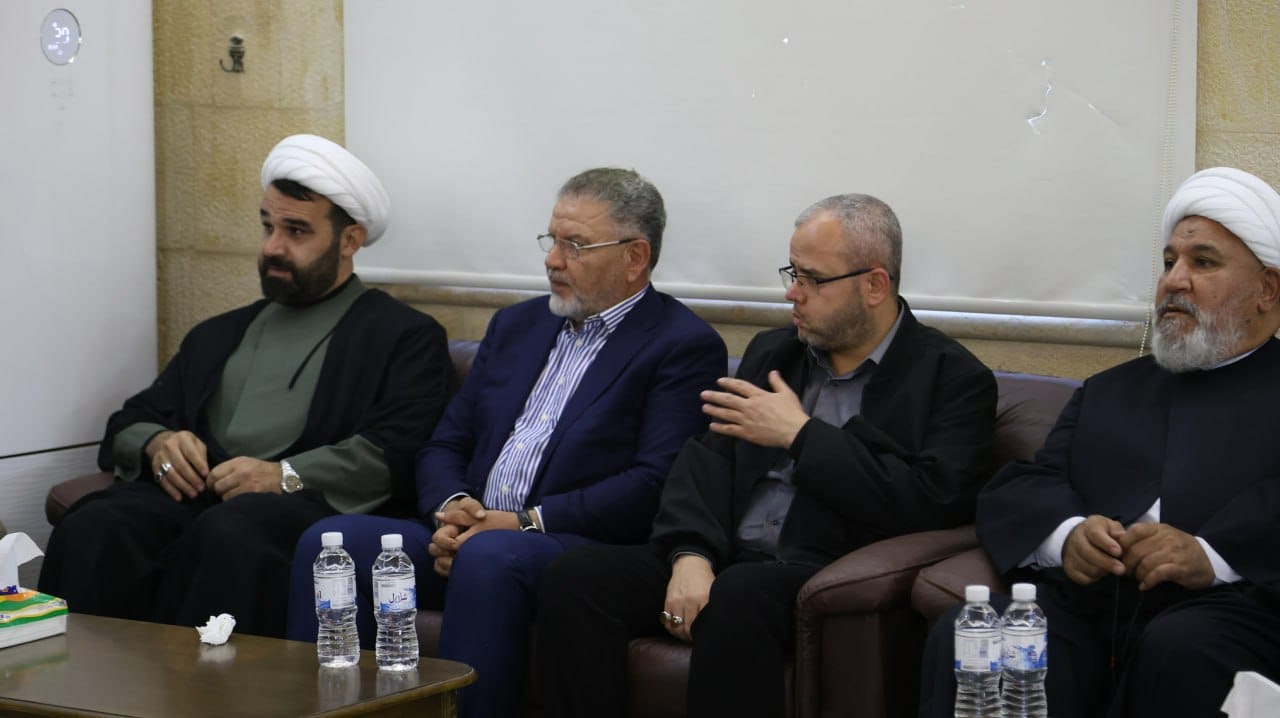
The forces attack Hezbollah: its weapons force negotiations with Israel
16:42 · 14 April 2026
5 min read

The Press Office of the Lebanese Forces party issued the following statement:
We had hoped, in these delicate, difficult, and tragic circumstances, to avoid entering into political bickering, and to devote ourselves to pulling Lebanon out of the dark tunnel into which Hezbollah has dragged it, amid rampant death, unprecedented displacement, massive destruction, and economic paralysis. However, what Sheikh Naim Qassem said in his appearance yesterday is impossible to overlook or skip over, due to the many fallacies it contains, which it is unacceptable to remain silent about after all the sins committed by Sheikh Naim's party against Lebanon and its people. Instead of apologizing to the Lebanese, he reiterates rigid positions and stale, outdated approaches that have nothing to do with either history or geography.
The facts speak for themselves. They are the strongest evidence that admits no interpretation and needs no explanation; presenting them alone is enough to reveal the truth:
- The first fact: It suffices to compare Lebanon's financial, economic, touristic, urban, and political reality between 1949 (the Armistice Agreement) and 1969 (the Cairo Agreement), and its reality after being turned into an arena, Hezbollah's inheritance of this arena, and its bringing of wars from every direction. Lebanon before the war was the "Switzerland of the East," but the "pro-Iran axis" turned it into an arena of death, killing, and destruction.
- The second fact: The claim that Hezbollah's strength is capable of deterrence and protection has collapsed on the battlefield. Israel withdrew from Lebanon in 2000, and the party itself is the one that brought it back, as a result of the wars it initiated, starting from July 2006, passing through October 2023, and up to March 2026.
- The third fact: Hezbollah did not stop at its coup against the constitution by insisting on possessing illegal weapons; rather, it continued this coup against the oath of office, the ministerial statement, and the government decisions of August 5 and 7, and March 2.
- The fourth fact: Hezbollah has turned into a foreign body in Lebanon. No influential group came out, as used to happen in the past, to support its wars and adventures, and it no longer has any ally or friend, despite their previous cover for its coup role against the state and the constitution.
- The fifth fact: Hezbollah declared the "Gaza support" war without referring to the state or paying heed to the Lebanese consensus, and then declared the "Tehran support" war in the same manner.
- The sixth fact: Negotiation with Israel was not on the table before the "Gaza support" and "Tehran support" wars; rather, Lebanon linked its position to the 2002 Beirut Peace Initiative. Those who placed Lebanon on the negotiating table are Hezbollah's pointless wars.
- The seventh fact: Those who did not implement the Lebanese constitution, which stipulates the state's monopoly on weapons, are the very same ones who did not implement Resolution 1701, which affirms the state's authority in this regard, and the very same ones who failed to abide by the November 27 agreement, which clearly defines the party authorized to bear arms.
- The eighth fact: The demand to disarm Hezbollah is a Lebanese demand first and foremost, before being the demand of any external party. Indeed, one of the most prominent criticisms of the international community is that it did not support the implementation of the Taif Agreement when it was issued, which paved the way for the persistence of these weapons and dragged Lebanon into successive wars.
- The ninth fact: Experience has proven the impossibility of building a stable and prosperous state under dual authority. Stability cannot be achieved in light of war decisions taken outside legitimate institutions. What we are witnessing today, particularly in the south, of destruction and displacement, is nothing but a direct result of this approach.
- The tenth fact: Lebanon's true strength was when the state was the sole authority, making it a stable and prosperous country, with per capita income on par with developed countries, and a destination for investment, tourism, and media. But Hezbollah turned it into an isolated and struggling state, whose children emigrate instead of opportunities flowing into it. Lebanon's strength has never lain in weapons outside the state, but in a state of law and institutions, as manifested in the sixties, when the economy was booming and society enjoyed a high degree of stability.
This strength Israel was unable to wrest from Lebanon, but Hezbollah is the one that undermined it through its wars and the divisions it caused, until Lebanon reached one of its worst economic and social crises, with the retreat of state institutions and an unprecedented deterioration in the livelihood of the Lebanese.
It is becoming increasingly clear that the forces gathered in "Maarab 3" were not mistaken when they demanded not only the disarmament of Hezbollah, but also the holding accountable of those responsible for plunging Lebanon into an unprecedented catastrophic path.
In this story:
Naim Qassem

← Previous article
Mitri: The President of the Republic is negotiating on behalf of Lebanon... Negotiating does not mean recognizing Israel
Related Articles
Jumblatt: Lebanon-Israel negotiations will not bear fruit as long as Israel occupies the south
Hasbani: The Dahr al-Baidar incident is a gateway to implementing the government’s decisions regarding the party’s weapons
Contact between Al-Hajjar and his Saudi counterpart... enhancing joint cooperation between the two countries