The security situation is stuck... Aoun: I will not allow the steadfast people in the south to be accused of being collaborators
18:15 · 07 April 2026
17 min read

President General Joseph Aoun affirmed that the responsibility of maintaining security in the Lebanese interior under these circumstances is shared and requires full coordination between citizens, the army, the security forces, and municipalities. He stated that the army has carried out a redeployment in Beirut and several other areas, and will have a greater presence alongside the Internal Security Forces and other agencies, with a stricter enforcement of security to reassure citizens who are safe in their homes.
He pointed out that the current security situation is under control and there is no fear of strife or internal security chaos, and that the problems occurring are limited and being dealt with as quickly as necessary. However, there are those who focus on building upon the fear of sectarian strife to serve their own interests. The current circumstances differ from the past, as there is comprehensive awareness among the people, as well as political and spiritual leaders, because no one has the capacity to bear internal strife. There is a decision to cut off the hand of anyone who attempts to extend it toward civil peace. He said: "I will not allow strife to occur, and anyone who tries to fuel this trend, whether through social media or the media, poses a danger to Lebanon and commits an act worse than Israeli attacks. We must distinguish between national interest and foreign interests, and we have no salvation except the state."
President Aoun praised the resilient residents across various areas of the South, and affirmed that during his term, no citizen who remained steadfast in his village and town will be allowed to be accused of collaboration or treason simply because he chose to continue living in his birthplace. He stated that he is doing everything necessary to ensure that villages and towns not yet attacked by Israel are not targeted.
The President of the Republic emphasized that he is continuing his contacts with brotherly and friendly countries regarding the negotiation initiative he launched, which has gained international support as the proper path to reaching a solution—especially since Lebanon previously concluded agreements with Israel, such as the armistice agreement and the maritime demarcation agreement. Contacts are also focused on securing guarantees that the Masnaa border crossing, which is essential for both Lebanon and Syria, will not be targeted.
President Aoun clarified that what the Lebanese Army is doing in terms of carrying out the tasks entrusted to it is an achievement in itself, and it is impermissible to attack it or target it under any pretext. What it is doing is an exceptional effort given the available capabilities, and it has not hesitated to fulfill what is asked of it to safeguard the security of Lebanon and the Lebanese, much like the other security forces.
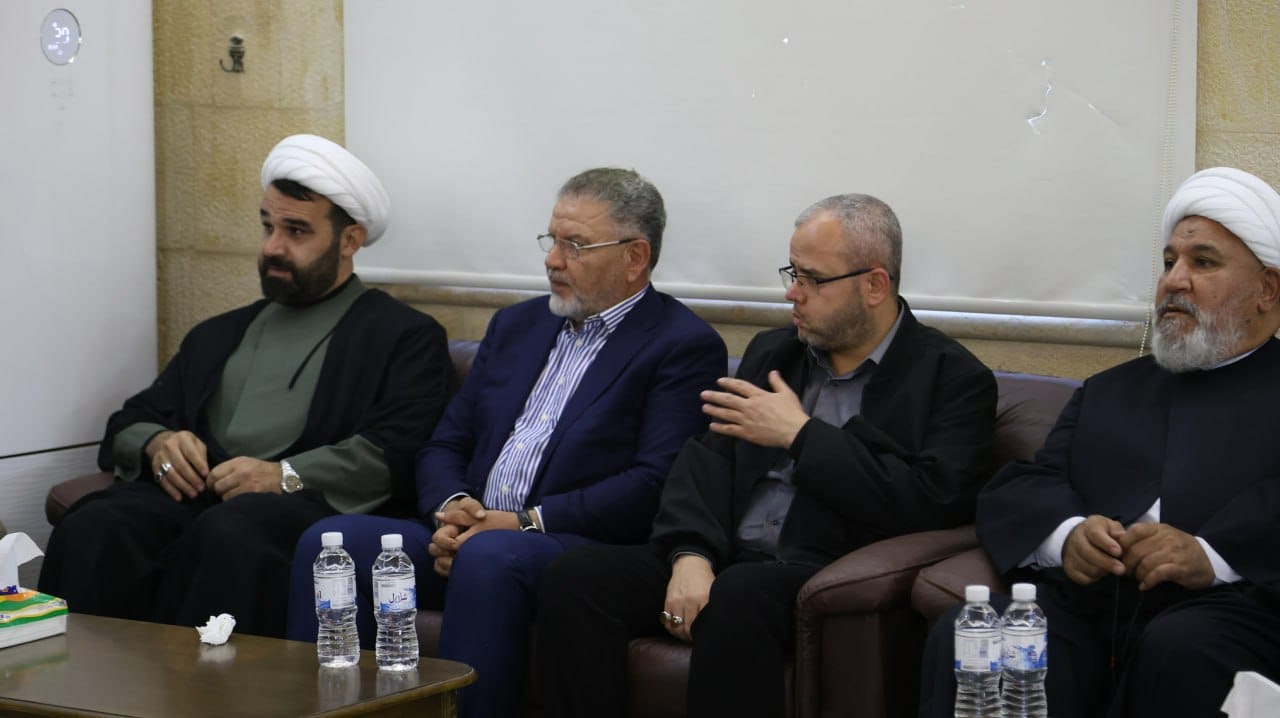
President Aoun's remarks came during his meeting before noon today at the Baabda Palace with MP Fouad Makhzoumi and a delegation from the Beirut Forum, who discussed with him the reality experienced by the capital and presented their vision of what can be done to enhance stability and security in Beirut, in addition to improving the general situation in all Lebanese regions.
MP Makhzoumi's Statement
After the meeting, MP Makhzoumi spoke to journalists, saying:
"Following today's meeting with His Excellency the President of the Republic, General Joseph Aoun, alongside the brothers in the Beirut Dialogue Forum, we affirm that the priority of this phase is Lebanon's security, starting with Beirut, and the protection of the Lebanese. We presented to His Excellency the totality of the national, sovereign, security, and reform issues that Lebanon faces at this delicate stage. We stressed that the Lebanese people cannot be protected except by taking decisions, especially after what we witnessed of the use of Lebanese as human shields in Aisha Bakar, Raouche, Baabda, Sidon, Al-Janah, and most recently in Ain Saadeh. This requires an immediate transition to practical and exceptional measures, most notably:
1- Calling for an immediate meeting of the Supreme Defense Council, taking exceptional security measures, and raising readiness to the maximum degree.
2- Enhancing the deployment of the army and decisively activating the role of the security forces and intelligence.
3- Compelling the proper registration of all tenants and occupants and subjecting vacant apartments to periodic monitoring, while imposing severe fines, up to imprisonment, for any unauthorized rental or occupancy."
We also stressed the need to implement the Beirut security plan that we put forward on March 25, placing the capital under the full authority of the state as a fundamental entry point to cementing stability—meaning a Beirut free of weapons.
Regarding the South, we stressed the necessity of not abandoning our people who insisted on staying in their villages, and the imperative of ensuring a tangible state presence alongside them, because they are Lebanese citizens who must be protected. We must not repeat what happened in the 1970s and 1980s when they were left to face the Israelis, and then subsequently faced unfair accusations of collaboration.
Within the sovereign framework, we affirmed that any rebellion against the decisions of the Lebanese state, including what was issued by the Iranian ambassador, requires decisive measures, beginning with stripping him of his political status and reaching the point of suspending diplomatic relations with Iran should this defiance of state authority persist.
We also support the initiative of His Excellency President Aoun, and stress the need to pursue a clear political path that ends the cycle of wars by entering into direct negotiations with Israel, with the aim of putting an end to the ongoing war that brings destruction and bloodshed to Lebanon as a result of decisions made outside the framework of the state. We also affirm our insistence on the government adopting a clear economic and financial strategy to confront this crisis, and developing an integrated plan for the post-war phase. It is no longer possible to rely on foreign aid as before—whether from the Lebanese diaspora or friends of Lebanon—which necessitates a serious and responsible domestic approach to rescue the national economy.
In the broader national context, we affirmed limiting the decision of war and peace to the Lebanese state, the full implementation of international resolutions without selectivity, the restoration of full sovereignty, and the rejection of any reality outside the framework of legality. We also called for the protection of public order and the enhancement of internal stability, alongside the adoption of an integrated national approach to address crises, including displacement, in a manner that preserves balance and justice across all Lebanese territory, starting with Beirut.
We also reiterated the security measures previously proposed in the Beirut Operations Room following the Aisha Bakar and Raouche incident—namely, compelling the proper registration of all tenants and occupants, subjecting vacant apartments to periodic monitoring, and imposing severe fines up to imprisonment for any unauthorized rental or occupancy—which have not yet translated into executive steps despite urgent need.
We also touched upon the issue of Islamist detainees and the general amnesty, insisting that this time it must be comprehensive, fair, and applicable to all. Finally, we raised a question regarding Resolution 1701 and the clause in Article 14 which stipulates that after the government rejected the implementation of Chapter VII in 2006, it insisted on having the right to request military assistance from our allies if the resolution could not be implemented. We raised this issue with His Excellency the President so that he may seriously bring it up in the government to discuss how to benefit from our allies in the region to enforce the implementation of Resolution 1701 and the process of restricting arms to the state. Based on our vision to restore the state and protect Lebanon, as we previously presented, we affirm that the stage no longer tolerates delay. Protecting Beirut is the gateway to protecting Lebanon, and extending the full authority of the state is the only way to guarantee the security of the Lebanese. Every delay is no longer measured in time, but in blood."
Asked: What is your response to the criticisms leveled against the state, accusing it of being incapable of protecting citizens?
He replied: The government, through its historic decisions taken on August 5 and 7, and on March 2 of last year, is essential. However, there is a state of coup from within. Hezbollah, which participates in the government and parliament and is present when decisions are made, is rebelling against the government, alongside which the entire Lebanese people stand. We must stand with the government against Hezbollah, which will lead us to ruin.
Asked: Where does the proposal you submitted after the Aisha Bakar and Raouche incident stand?
He replied: What we heard from His Excellency the President is that instructions have been given to the army, and a brigade will deploy in Beirut and is currently in the process of deploying. We demand that the Governor of Beirut implement this decision to find out who is present in these apartments in coordination with the security agencies, and there is a readiness by everyone to implement it if the intention is there."
Minister Al-Hajjar
Earlier in the morning, President Aoun received the Minister of Interior and Municipalities, Ahmad al-Hajjar, and asked him to enhance the deployment of Internal Security Forces elements and units in the capital and Lebanese regions, to activate coordination between them, the Lebanese Army, and municipalities to ensure the highest degrees of security, and to strictly apply the law against violators and anyone threatening civil peace.
Minister Al-Hajjar briefed the President of the Republic on the security situation in the country in light of current developments, and the steps being undertaken by the Directorate General of Internal Security Forces and its subordinate units to preserve security stability.
Minister Al-Hajjar spoke after the meeting, saying:
"Today I visited His Excellency the President, with whom I have been in constant contact around the clock recently regarding developments, especially on the security front. Today I briefed him on the atmosphere of all the measures being undertaken by the security agencies in coordination with the Lebanese Army, and the meetings I held, including with the Governor of Mount Lebanon and the district commissioners of Jbeil and Keserwan, where I discussed with them the conditions of their regions in light of recent events, the measures that must be taken, and the essential role of municipalities. I also briefed His Excellency on the atmosphere of the meeting I held with the Director General of Internal Security Forces and the head of the Information Branch, where I requested taking further measures and security presence across all Lebanese regions, especially those requiring a greater security presence to reassure the people. His Excellency the President also gave his directives to the army to enhance its presence, and coordination will be complete between the security agencies, the army, and municipalities, which will be reflected in greater reassurance for the people and citizens safe in their homes, because no one has any refuge except the state, and this is what we must hold fast to. I will carry out further follow-up in the coming days on both security and administrative levels, in coordination of course with the other security and military agencies.
Today's meeting also touched upon the Masnaa crossing and the threat it previously faced, and His Excellency the President is making all necessary contacts, hoping that we will be able in the near future to reopen this vital crossing for both Lebanon and Syria."
Asked: How will additional security personnel be secured in the regions? And how do you confront the fear of citizens in areas hosting displaced persons?
He replied: "This important matter is being followed up, and municipalities play an essential role—most of them are fulfilling it significantly. In the coming days, we will witness further efforts by municipalities and higher coordination with the concerned security agencies, namely the Internal Security Forces, General Security, and Army Intelligence... I requested full responsiveness from the agencies affiliated with the Ministry of Interior toward municipalities, to work as much as possible to spare citizens from exposure to events of a tragic nature. There will be a greater presence of the Internal Security Forces and the army, and the execution of a deployment based on the analysis of data and information and where the security presence needs to be reinforced."
Slept/Asked: The army withdrew from southern Christian villages, but the security forces are present; what is the situation there?
He replied: "This matter is of concern to His Excellency the President, not only regarding Christian villages, but all border villages, and we have discussed it repeatedly. I recently met with delegations from villages in the Hasbaya and Arqoub regions, and communication is constant with all these villages and the governors of the South and Nabatieh. There is a decision by the Internal Security Forces to remain in the regions witnessing the steadfastness of residents in their homes and regions, and the state wishes to provide them with the necessary support, which is being followed up at all levels—not just the security level, but also by all other state administrations."
Asked: Can we expect additional foreign aid to arrive?
He replied: "Yes, there are ongoing contacts by His Excellency the President, the Prime Minister, and all concerned parties, and we hope more support will arrive in the coming days."
MP Adib Abdel Massih
On the parliamentary level as well, President Aoun received MP Adib Abdel Massih and discussed with him the latest local and regional developments.
After the meeting, MP Abdel Massih made the following statement:
"I came to congratulate His Excellency the President on Easter, and to affirm my support for every word he said in his press conference at the patriarchal seat in Bkerki. I expressed this in a post I made, in which I pointed out that the national Easter message came from His Excellency the President on this day.
We also touched upon during the meeting the economic conditions and the ongoing war for about 40 days, whose dimensions and destination we do not know. But what I want to emphasize is that between the logic of the state and the logic of the mini-state, we choose the state; and between the logic of Israel and Hezbollah, we choose the state. There is no alternative to the state. When we say 'the state,' we mean first the Presidency of the Republic, which is the head of the state, and our duty, especially in times of war, is to stand behind it to remain united, and to preserve national unity, which is the path to salvation. We prefer a thousand wars upon us rather than a single internal war among the Lebanese. Therefore, the Presidency of the Republic is playing its role as an arbiter, and the words expressed by His Excellency the President in Bkerki show that he is a protector of the constitution, equidistant from all Lebanese, and the man who put his finger on the wound and called things by their names. We all know who His Excellency the President meant by his words, what his goal was from the conference, and the national backgrounds of his speech."
He added: "Secondly, by the state we mean the government, which, regardless of the divergence within it, we must stand behind as an institution to achieve peace—since we are in a state of war—and to achieve security and safety for the Lebanese, restore Lebanon's role in its environment, and subsequently achieve reconstruction, economic restructuring, revitalization, and so on.
Thirdly, we mean the Lebanese Army and the Lebanese security forces. It is completely unacceptable for Lebanese politicians, political forces, deputies, and partisans to target the Lebanese Army and the security forces. What is the alternative to the army and the security forces? When we target the army, its commander, and the security forces, and constantly criticize them, we thereby provide a service to Israel and Hezbollah, and strengthen illegitimacy at the expense of legitimacy. Is this the discourse required today in a time of war, where there are thousands of victims, thousands of wounded, and our homes are being demolished? Is it conceivable to have a sovereign and national discourse that does not mention Israel? Of course, we have an internal problem, and a faction dragged us to war and does not recognize the state, but this does not negate the fact that we are targeted today by an enemy that kills our children, displaces our citizens, and destroys our property. And this must be mentioned."
He continued: "The history of Lebanon teaches us that there is no alternative to the state. When the state weakens or collapses, war breaks out and calamities befall us. Therefore, it is essential to stand behind the state, strengthen it, strengthen the Lebanese Army, and demand that friendly countries and the international community support it so it can carry out its duties, rather than targeting it. If there is any shortcoming on the part of the army, it is due to not providing it with capabilities. I would like to emphasize here that at the beginning of the recent war, 90% of the rockets launched toward Israel came from north of the Litani, not south of it, as some promote, and the reason was that the Lebanese Army was there and controlled south of the Litani. It is shameful not to mention the facts and to target the sole legitimate institution around which we can rally to be the only refuge if we truly want the existence of the state—or unfortunately, there are unknown agendas aimed at weakening the state, and we do not know who will take its place. We must stand as an impenetrable dam, and therefore I came today to offer my full support to His Excellency the President and his political and national discourse, and my unconditional support for the security forces and the Lebanese Army, because they are our only refuge in times of peace and war."
Asked: There is a fear among the Lebanese of certain displaced persons being targeted in their regions; is there a plan to confront this matter?
He replied: "I touched upon this with His Excellency the President. What is required today from the security forces, intelligence, the Lebanese Army, those concerned, and even the citizens, is to exercise more strictness in information, inquiry, and monitoring of elements infiltrating among civilians. This requires responsibility from the local community, which must monitor any suspicious movements, and this campaign must begin as a matter of urgency. The watchful eye is not just the security forces and the Lebanese Army, but the citizen himself. The security forces and the army, without the citizen and his information, cannot fully carry out their tasks. We all have a shared responsibility to monitor these elements, and of course the informational and intelligence responsibility rests with the security forces because they have the capabilities to monitor these elements and keep them away from residential areas. There is also a responsibility on property owners, apartments, and municipalities, whose job is to tighten supervision over residential units."
Asked: Israel conditions a ceasefire on the dismissal of the army commander; how do you respond to that?
He replied: "Do you think there is a single officer in the army today who holds a doctrine different from that of General Rudolph Haikal? Is there a single member of the Military Council, or any general in the army, who has a different view from the army commander? We defend General Haikal because he holds a position in an institution that we stand behind. All members of this institution are trained, prepared, and have sufficient experience so that the army achieves the country's interest and not the interest of one faction at the expense of another faction, or one party at the expense of another party. What Israel demands means that the army commander is the right person in the right place."
In this story:
Joseph Aoun

← Previous article
“Restraint has ended”... The Revolutionary Guard threatens to strike energy facilities in the region
Related Articles
Jumblatt: Lebanon-Israel negotiations will not bear fruit as long as Israel occupies the south
Hasbani: The Dahr al-Baidar incident is a gateway to implementing the government’s decisions regarding the party’s weapons
Contact between Al-Hajjar and his Saudi counterpart... enhancing joint cooperation between the two countries