High-Level Emirati Economic Delegation in Beirut: Memorandums of Understanding and Opening a New Chapter for Investment
20:34 · 26 August 2026
29 min read
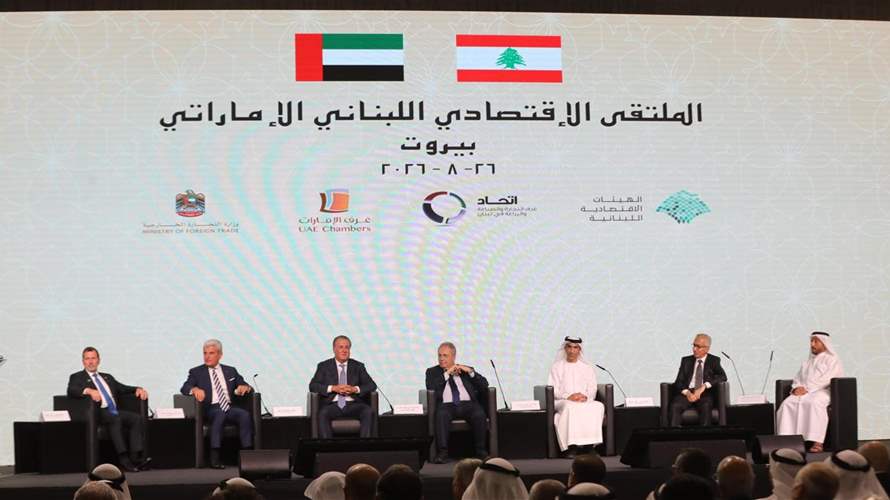
The Economic Organizations and the Federation of Lebanese Chambers, in the presence of the Prime Minister's representative, Dr. Nawaf Salam, Dr. Tarek Mitri, hosted a high-level Emirati delegation headed by the UAE Minister of Foreign Trade, Thani bin Ahmed Al Zeyoudi. The delegation included nearly 90 prominent Emirati business figures, investors, and economic leaders, aimed at boosting cooperation between the private sectors of both countries, exploring opportunities, and sustainably cementing the economic and investment partnership between the two nations.
Federation of Chambers of Both Countries
Activities of the visit kicked off with a meeting between the Federation of Lebanese Chambers, headed by former Minister Choucair, and the Federation of UAE Chambers, headed by UAE Chambers Vice Chairman Sultan Abdullah Al Owais, at the Seaside Arena. The meeting discussed consolidating relations, business facilitation requirements, increasing bilateral trade volume, strengthening partnerships, and cementing cooperation in Lebanon, Syria, Iraq, and countries of the region.
It was agreed to increase communication, coordination, and reciprocal visits to achieve the desired goals, as well as to benefit from experiences and exchange expertise.
Bilateral Business Meetings
Concurrently, bilateral business meetings were held between 50 businessmen from the Emirati delegation and around 120 businessmen from the Lebanese side across various sectors: trade, industry, agriculture, tourism, information technology, petroleum, gas, banks, infrastructure, and services, with the aim of exploring opportunities and discussing the possibility of establishing business partnerships between Lebanese and Emirati companies.
Al Zeyoudi's Meetings
Upon his arrival at the Seaside Arena, Al Zeyoudi held successive meetings with the head of the Economic Organizations and Minister of Economy and Trade Amer Al-Bsat, then with Minister of Industry Joe Issa El Khoury, Minister of Public Works and Transport Fayez Rassamny, and Minister of State for Technology and Artificial Intelligence Dr. Kamal Shehadeh. Discussions focused on ways to enhance cooperation, available opportunities, and potential partnerships between the two sides to achieve a qualitative leap in bilateral economic relations and establish a sustainable partnership.
Sustainable Business Meetings
Forum activities began at 3:00 PM today, opening with the national anthems followed by a speech by the ceremony's master of ceremonies, journalist Maurice Matta.
Choucair
At the beginning, the head of the Economic Organizations said: "I am pleased and honored, on behalf of all Lebanese, to warmly welcome the brotherly Emirati economic delegation, headed by His Excellency Minister Dr. Thani bin Ahmed Al Zeyoudi, and to express before you my utmost joy and happiness at his presence in Lebanon. We in Lebanon, and in Beirut specifically, have missed meeting our Emirati brothers, whom we consider dear brothers bound to us by deep and entrenched ties of affection, fraternity, and respect."
He added: "We are optimistic about welcoming the delegation today as it is the first economic delegation of this weight to come to Lebanon after difficult years through which we passed, marked by financial collapse, the COVID-19 pandemic, and the war that erupted on October 7. Your presence among us is a harbinger of goodness, a message of hope, and proof that our country has begun to recover and restore its standing, and an affirmation that Lebanon, with His Excellency the President of the Republic General Joseph Aoun, Prime Minister Dr. Nawaf Salam, and Parliament Speaker Nabih Berri, has begun to gradually restore the trust of brotherly Arab countries and the international community."
He continued: "There is no doubt that the summit meeting between His Excellency President Joseph Aoun and His Highness Sheikh Mohammed bin Zayed Al Nahyan, President of the UAE, laid the foundation for this new track and resulted in important steps, most notably: establishing business councils between the two countries, lifting the travel ban on Emirati brothers to Lebanon, and culminating in the visit of this high-level economic delegation today."
He said: "These successive steps reflect a clear will to reopen a new page of cooperation, investment, and partnership. As the Lebanese private sector, we see an available possibility to activate economic cooperation between the two countries on a broader and deeper scale, which is natural given that we are building on the great success achieved by the partnership between Lebanese businessmen and their Emirati brothers in the UAE, on the strength of our fraternal relations, on the differential advantages we possess, and on the great energies, experiences, and competencies enjoyed by the private sector in Lebanon and the UAE."
He added: "We have many promising energies and opportunities upon which we can build successful and sustainable partnerships. We have clearly sensed this since the very first event of this forum, represented by the bilateral business meetings that brought together nearly 50 prominent Emirati economic figures with a large number of Lebanese businessmen across various sectors. These bilateral meetings are perhaps the most expressive of the essence of what we want to build together, because real economic relations are not built solely through agreements, but through partnerships, projects, investments, and the creation of jobs and added value in both countries."
He continued: "God willing, Lebanon is approaching a promising phase during which it will begin the process of reconstruction and the development of its infrastructure and economic and service facilities. In this aspect, we have many projects that can be entered into via public-private partnerships and BOT concessions, and the omens of this governmental direction have begun to appear clearly through the concession granted to a company to redevelop and operate the President René Mouawad Airport in Kleyate, Akkar."
He noted: "In truth, we are facing major opportunities, and our ambition must not stop at the borders of our two countries. The integration between Lebanese and Emirati expertise and capabilities can open wider horizons for cooperation in promising brotherly markets, particularly in Syria and Iraq, reaching out to African markets and others."
He concluded: "We are confident that what brings Lebanon and the UAE together is much greater than economic interests; it is a history of fraternity, trust, and cooperation, which must be translated into a new economic partnership that is stronger, broader, and more sustainable. We ask God to protect the UAE, Lebanon, and their peoples, to end the cycle of wars, and to bestow upon our region and countries security, stability, and peace."
Al Owais
In turn, the Vice Chairman of the UAE Chambers said: "This economic meeting will pave the way for revitalizing and increasing the volume of trade exchange between the United Arab Emirates and the Lebanese Republic. Economic relations between the UAE and Lebanon date back decades, and since the 1970s, they have witnessed accelerated development in building economic partnerships and enhancing the movement of trade exchange between the two countries."
He added: "We in the Federation of Chambers of Commerce and Industry, in cooperation with our colleagues in Lebanon, are working to strengthen these relations. This morning, we held meetings aimed at exchanging expertise between the UAE chambers and the Federation of Chambers in the Lebanese Republic, stemming from a fundamental goal represented in strengthening and increasing the volume of trade and investment exchange, and enhancing the exchange of expertise between the United Arab Emirates and the Lebanese Republic. Furthermore, the positive and investment-motivating words in the Lebanese Republic constitute an important incentive for the Emirati private sector to increase its investments in various sectors, particularly industry, logistics, hotels, the health sector, and other sectors that will contribute to strengthening economic and trade relations between the two countries."
He continued: "In this context, we extend our deep thanks and appreciation to the Ambassador of the United Arab Emirates to the Lebanese Republic and the Ambassador of the Lebanese Republic to the United Arab Emirates for the important role they play in strengthening relations between the two countries and making this meeting a success."
Shehadeh
As for the Minister of State for Technology, he said: "Lebanon today is on the track of recovery and is advancing steadily on three main pillars: extending state authority across its entire territory, proceeding along the path of financial and economic reform, and cementing the rule of law. These tracks are the foundation for creating a stable and investment-attractive environment, and for turning the opportunities we are discussing today into sustainable projects and partnerships. In this context, we must thank the United Arab Emirates for its continuous support for Lebanon over past years and for standing by the Lebanese people. Today, we particularly appreciate its generous hosting of the Lebanese diaspora. This deep humanitarian and economic relationship constitutes an important asset upon which we build our future partnership."
He added: "Your presence in Lebanon today constitutes an opportunity for the UAE to open a new page in the partnership between Lebanon and the United Arab Emirates—a partnership we want to be based on investment, technology, innovation, and building a shared digital economy."
He continued: "The United Arab Emirates has cemented its position as a global powerhouse in technology, artificial intelligence, and the digital economy, not only as a pioneer in our region but globally. The UAE has also brought technology and private sector practices to the core of its work: a paperless government, integrated digital services, and management based on performance indicators and continuous measurement, to the extent that Emirati governmental performance itself has become a global standard. As for Lebanon, it possesses exceptional human energies of engineers, developers, entrepreneurs, researchers, and innovators, in addition to venerable universities and a private sector that enjoys a great capacity for innovation and expansion beyond borders."
He noted: "What we want is an equal partnership for the benefit of both parties, where each party builds on the strengths of the other. Hence, our ambition goes beyond merely a set of projects. We want to open new markets for Lebanese companies and talents, and at the same time create new opportunities for Emirati companies and investments in Lebanon and the region. But our ambition is greater than that; our ambition is to combine our capabilities to achieve together what is difficult for any of us to achieve individually. If we combine the assets of both countries, we can build together companies, products, and services capable of competing not only in our markets, but in global markets."
He concluded: "Our ambition is also to work gradually towards a shared digital market between Lebanon and Al-Emarat, governed by harmonized rules and standards, so that the work of companies, investments, digital services, data, and talents between our two countries becomes easier and more efficient. Beyond that, we look forward to building a partnership that serves as a regional role model and paves the way for the establishment of a unified market."
Issa El Khoury
For his part, the Minister of Industry said: "The relationship between Lebanon and the United Arab Emirates has never been anything other than a relationship of brotherhood and friendship between Emiratis and Lebanese. It is a historical and solid relationship woven by enterprising people before agreements stipulated it. Since the early years of the federation's establishment, Lebanese bankers, engineers, professors, doctors, industrialists, and merchants were at the forefront of those who headed to the UAE to contribute to building it, putting their sciences, expertise, and competencies to work, and joining hands with the people of the country for the sake of establishing a modern and developed state. In turn, the UAE opened its doors to them without reservation, during the days of Lebanon's prosperity, and most importantly, in its darkest and most difficult days. Lebanon does not forget that. And we do not forget who stood by our side."
He added: "Let me speak about what has changed. Over decades, the relationship centered around the contribution of Lebanese competencies to the UAE's rise. Today, however, it has entered a wonderful new chapter: the UAE has become a leading and advanced platform, not only in our region, but globally—a platform for finance, business, logistics, technology, investment, and ideas."
He continued: "Now, I will speak clearly, as a Minister of Industry addressing businessmen and businesswomen, for business people appreciate frank talk. You hear, in many forums, talk about Lebanon's need for grants, aid, and support. This talk pertains to the public sector, and it is legitimate talk. But it is not the talk of the Lebanese private sector. The private sector present before you today does not ask for grants, nor does it ask for aid. The private sector proposes one thing: your investment in Lebanon and our partnership with you—investment on commercial terms, evaluated according to its commercial viability, and achieving commercial returns. Lebanese industrialists have withstood every crisis this country has passed through. They have remained steadfast, producing, exporting, and competing."
He concluded: "They are not a burden in need of support, but an opportunity worthy of investment. And this opportunity is wider than you might expect."
Al-Bsat
Stressng four points, the Minister of Economy said: "First: Lebanon's productive capabilities are much greater than what it produces today. We have a dynamic private sector, exceptional human competencies, and deep relations with the region and the world. These assets have not disappeared because of the crisis. These potentials can be turned into real opportunities. Major investment opportunities sometimes begin before recovery is complete, when its features begin to appear. Hence comes the importance of your visit today."
He added: "Second: Potentials alone are not enough; turning them into growth and prosperity requires real reform: for the banking sector, the financial framework, basic services, and the way the state operates. It also requires cementing a non-negotiable principle: state sovereignty, the exclusivity of arms, and the decision of war and peace resting solely with the state, emphasizing that no economy will flourish, and no investor will plan with confidence, if these decisions are not in the hands of the state alone."
He continued: "Third: Recovery must be, in its essence, a private sector project. Here, the UAE provides an important model: a state that does not replace the private sector, but prepares the conditions for its success—clarity of rules, ease of doing business, long-term planning, and openness to competencies, capital, and global markets. We have a strong foundation to build upon. The Lebanese private sector is one of the most pioneering sectors in the region, and a large part of it has found a second home in the UAE. Therefore, when I look at this hall, I do not see two economic delegations that are strangers to each other, but a business community bound by relations and partnerships built over decades."
He noted: "Fourth: We must turn this relationship into a deeper economic partnership. One of the most important elements of the Emirati experience is its integration into the global economy. This was a conscious choice, translated into trade agreements and comprehensive economic partnerships. Lebanon has lagged far behind in this field. And it is time for us to change that."
He concluded: "Therefore, I propose today that we begin exploring a special economic partnership framework between Lebanon and the UAE—a practical track to deepen trade and investment, transfer knowledge, and link our companies and markets. In doing so, we want not only your partnership, but also to benefit from your experience and expertise."
Al Zeyoudi
As for the Emirati minister, he said: "I am pleased to be among you today at the launch of the proceedings of the UAE-Lebanese Business Forum, which brings together an elite group of business leaders, investors, and decision-makers from the United Arab Emirates and the brotherly Lebanese Republic. At the outset, I extend my sincere thanks and appreciation to the Lebanese brothers for the warm reception and generous hospitality we have received, and I thank the organizers of this forum, whose good organization embodies the team spirit that brings our two brotherly countries together."
He added: "The world is currently witnessing rapid transformations in patterns of trade, investment, supply chains, the digital economy, and advanced technology. In light of these variables, effective economic partnerships have become more important than ever, not only to achieve growth, but to enhance competitiveness and benefit from the opportunities offered by rapidly changing global markets. From this standpoint comes the importance of this forum that brings us together today. It is not merely a platform for dialogue and the exchange of ideas, but a practical space to explore new opportunities for cooperation, build qualitative partnerships, and develop projects capable of achieving real added value for the economies of our two brotherly countries."
He continued: "Successful experiences around the world have proven that governments can draw visions and provide the business environment enabling success, but the private sector remains the primary engine for economic growth, innovation, job creation, and attracting investments. Hence, the success of economic relations between countries is ultimately measured by the number of partnerships built, investments executed, and opportunities created on the ground. Therefore, we view the brothers and sisters participating in this forum from business leaders and private sector representatives as essential partners in shaping the next phase of constructive economic cooperation between the UAE and Lebanon."
He said: "Today we have strong foundations to build upon and launch into broader horizons of trade and investment cooperation that achieve the developmental aspirations of our two countries and brotherly peoples. Our non-oil trade value reached $4.2 billion during 2025, achieving an annual growth rate of 35.6%. These figures reflect the great potentials available to us to continue consolidating our economic partnership over the coming years."
He added: "Furthermore, the broad participation of the private sector and the Emirati business community in this visit reflects the growing level of confidence in the opportunities available in the Lebanese market, and the serious desire to build long-term partnerships based on achieving mutual interests and joint growth. The Emirati delegation participating with us today includes representatives from a wide range of vital sectors, including logistics, food security, agriculture, healthcare, oil and gas, renewable energy, aviation, artificial intelligence, and tourism. These sectors not only represent areas for cooperation, but constitute key engines for future economic growth and sustainable development."
He continued: "We believe that there are promising opportunities for cooperation in these promising sectors, contributing to enhancing the competitiveness of both countries' economies and creating new opportunities for the private sector. We also believe that Lebanon possesses a true wealth represented in its human resources and scientific competencies. The Lebanese diaspora has proven a distinguished presence in the UAE and has contributed over decades to many success stories in business, innovation, technology, and professional services."
He said: "Over past years, the United Arab Emirates has adopted a clear vision based on building long-term global economic partnerships, enhancing its openness to promising markets, and cementing its position as a global hub for trade and investment. Within this framework, the country launched the Comprehensive Economic Partnership Agreement program, which has succeeded in building a growing network of trade and investment partnerships with some of the fastest-growing economies in the world, contributing to facilitating trade and investment flows and opening new horizons for the private sector to reach strategic global markets."
He added: "From here, I would like to invite the Lebanese business community to benefit from this integrated system and from the UAE's network of trade and investment partners spanning various continents. Currently, the UAE provides not only a competitive business environment, a strategic location, and world-class infrastructure, but also a gateway to reach markets comprising billions of consumers around the world."
He continued: "We see that Lebanese companies, given the expertise, competencies, and competitive capabilities they possess, are qualified to benefit from these opportunities, whether through expansion starting from the UAE towards global markets or by building strategic partnerships with Emirati and international companies operating in the country."
He concluded: "We look to the coming phase with optimism and confidence. Today, a real opportunity is being prepared for us to move our economic relations to a new level; the best partnerships are those built on trust, the best investments are those that create a sustainable impact, and the best opportunities are those for which we possess the vision to utilize at the appropriate time."
Mitri
Prime Minister Salam's representative said: "It goes without saying that the Prime Minister sees in this visit an expression of the restoration of confidence in Lebanon, regardless of the difficulties posed. The difficulties are great, but our national will is also great, alongside the capacity of the active forces in Lebanon to persevere and rise."
He added: "As you all know, our country has carved a path towards restoring its sovereignty, and this path is rugged, which is why we need the support of our Arab brothers and our friends in the world. Restoring sovereignty has a dual objective: stopping the war, ending the occupation, and preserving the unity of Lebanese territory and its safety on the one hand; and on the other hand, extending state authority over all its territory so that it is the sole decision-maker in war and peace and possesses the exclusivity of arms. Restoring sovereignty is intertwined with the return of displaced persons to their homes, securing the conditions of life for them, and rebuilding what was destroyed. This places a great responsibility on the state to care for its citizens, preserve their lives and livelihoods, and provide aid to them without hesitation or condescension."
He continued: "I renew my welcome to you, and I pray to God Almighty that this forum be not only a space for dialogue between friends and their counterparts, but a strong new foundation upon which the fraternal relationship between our Emirati and Lebanese peoples rests. The threads of this relationship were woven since the days of the late Sheikh Zayed bin Sultan Al Nahyan, may God rest his soul, who opened the doors of the UAE to Arab brothers, foremost among whom were the Lebanese. They were hosted in increasing numbers, and they were loyal to the UAE in their toil, building, and development."
He said: "The United Arab Emirates has become a destination for the elite of our university graduates and experts in economics, informatics, agriculture, and industry. Therefore, today's meeting is not for mere acquaintance, nor will it be, God willing, a fleeting occasion, but an opportunity to strengthen relations of trust, communication, and partnership. Lebanon was and remains an open country, and a society possessing rich human energies, capable of turning the limitation of its resources into an incentive for knowledge, innovation, and initiative. As for the United Arab Emirates, it has become a unique model in achieving exceptional renaissance—an inspiring renaissance in vision and action, in ambition and successes."
He added: "I do not need to speak before you about the potentials opened by the partnership between our two countries, especially between businessmen and businesswomen. You are more experienced than I in the relentless pursuit of bringing benefits and warding off harms, but I trust that your coming to us is a testimony to your affection and your belief that the Lebanese are capable of rising, no matter how harsh the days. They have demonstrated this time and again. It is no secret to any of us that the Lebanese state, across all its institutions, is called upon to be worthy of your trust as well as the trust of the Lebanese, and this is its duty and custom."
He concluded: "The foremost responsibility of our government is to strengthen state institutions through reforming them, cementing the rule of law, restoring financial regularity, improving the business environment, developing infrastructure, and providing job opportunities by encouraging investments."
Al Mazrouei
For his part, the Undersecretary of the Department of Economic Development – Abu Dhabi, Hamad Sayah Al Mazrouei, said: "Our message is clear: do not look at Abu Dhabi as a market only; look at it as a platform—a platform through which you can establish your businesses, access capital, build partnerships, and expand to regional and global markets."
He added: "In Abu Dhabi today, there is an ecosystem of promising sectors including advanced manufacturing, artificial intelligence and technology, trade and logistics, clean energy, healthcare and life sciences, food and water security, tourism and creative industries, and financial services. True partnership does not go in one direction. Just as we welcome Lebanese companies and competencies in Abu Dhabi, we also look forward to a new phase of cooperation allowing Emirati companies and investors to participate in promising economic opportunities in Lebanon."
He continued: "Lebanon possesses distinguished human capital, a private sector enjoying an entrepreneurial spirit, a strategic location, and economic capabilities that can be built upon. We see promising fields for cooperation and investment in infrastructure and logistics, energy and renewable energy, digital transformation and technology, food security and food industries, tourism and hospitality, healthcare, and financial services."
He concluded: "What we aspire to is building long-term Emirati-Lebanese partnerships combining capital, expertise, and capabilities in both countries, taking our economic relations to a new level of integration and mutual benefit. I believe our role as governments is clear: to open doors, remove barriers, facilitate doing business, and build trust. As for real investments, partnerships, and projects, they are created by the business community in our two countries. Therefore, I hope we do not leave this forum today with ideas and intentions only. We want to emerge from it with clear opportunities, new partnerships, and actionable projects, and for this visit to be the beginning of a new economic phase between the UAE and Lebanon, based on investment, talent, innovation, and mutual interests."
Buamim
In turn, the Chairman of the UAE-Lebanese Business Council from the Emirati side, Hamad Buamim, said: "The relationship between Lebanon and the UAE, and what was affirmed regarding it, as well as the available opportunities and potentials, are all important matters. However, today, as the Chairman of the UAE-Lebanese Business Council from the Emirati side, I would like to focus on one point, which is: what shall we do from here? This forum, frankly, constitutes an achievement, and we see that the UAE and Lebanon, and the governments in both countries, have paved the way to set strong foundations. Today we move to the role of the council and the role of the private sector."
He added: "I believe our ambition from the council, in cooperation of course with our brothers on the Lebanese side, is to be a council of work and results, and not merely a platform for meetings and dialogues. Our goal through the council is to link businessmen and investors in both countries, identify opportunities in a clear and actionable manner, and encourage the partnerships and projects we talked about and turn them into reality. As well, to work with governmental and concerned entities to identify challenges and, God willing, work to solve them."
He continued: "We all know today that capital needs trust, and trust needs reform, and God willing with the return of trust, capital returns as well. As the brothers said, we do not want to wait until all matters are resolved, but we want to start from today, because we are confident that matters, God willing, are heading towards the better soon. We also want the council, as my brother Hamad said, to enshrine a relationship that goes in two directions: Emirati investments and opportunities in Lebanon, and at the same time helping Lebanese companies and existing competencies to benefit from the United Arab Emirates as a platform to reach the world, because we are indeed prepared for that."
He concluded: "The success of the council, God willing, will not be measured by the number of meetings and gatherings, but by the number of opportunities we can turn into actual partnerships and projects. We are optimistic, God willing, about what can be achieved, and our ambition is to work with our colleagues on the Lebanese side to reach tangible results that serve both parties."
Daher
As for the Chairman of the Lebanese-Emirati Business Council, Wassim Daher, said: "I am pleased to welcome the brotherly Emirati economic delegation, headed by His Excellency Minister Dr. Thani bin Ahmed Al Zeyoudi, to Lebanon, and to express our pride in the historical relations binding our two countries and peoples. The UAE has embraced the Lebanese for decades, providing them with opportunities for work, success, and creativity, thus being a second home to them and a preferred destination for investment and partnership."
He added: "We appreciate the UAE's permanent support for Lebanon and its keenness on its stability and prosperity. Stemming from the trust that brought the presidents of the two countries together, the Chamber of Commerce, Industry and Agriculture of Beirut and Mount Lebanon, headed by His Excellency Minister Mohammad Choucair, formed the Lebanese-Emirati Business Council, which includes an elite group of Lebanese businessmen with experience and entrenched relations in the UAE. The council was decided to be formed to be a practical platform to enhance cooperation, exchange expertise, and open new horizons for the private sector."
He concluded: "We look forward today to moving from coordination to mutual partnerships, projects, and investments, and building long-term strategic cooperation that benefits from the capabilities and expertise of both countries. In conclusion, I extend my thanks to the brotherly UAE, leadership and people, wishing it continuous progress, leadership, and prosperity, and for Lebanon stability, rise, and prosperity."
Al-Ariss
Then the President of the Federation of Lebanese-Gulf Business Councils said: "Lebanon opens its arms to welcome you, you who have never stinted with your affection and giving to our country Lebanon. We in the Federation of Lebanese-Gulf Business Councils place at the core of our objectives working to develop economic relations between Lebanon and the brotherly Arab Gulf states through launching programs and initiatives to network the Lebanese private sector with its Gulf counterpart, particularly in major projects implemented by the Gulf states, contributing to preserving the important role that the Lebanese private sector has long played, for centuries, in these brotherly states, and developing this role in a manner compatible with new economic and investment opportunities."
He added: "We also work to secure the engagement of the Gulf private sector in projects and investments proposed in Lebanon, in both the public and private sectors, enhancing the economic partnership between the two sides, opening new horizons for cooperation and investment, and turning the distinguished relations binding Lebanon and the Gulf into sustainable and fruitful economic partnerships for both parties. We highly appreciate what the brotherly Gulf states represent as an economic and social incubator for Lebanon, and what they have provided and continue to provide in terms of support and backing for Lebanon and the Lebanese. Within this framework, we view the brotherly United Arab Emirates as playing a distinguished and advanced role, constituting a pioneering model in supporting human and economic relations with Lebanon, and in building partnerships based on trust, openness, and mutual interest."
He concluded: "We say to you today: Thank you for everything, thank you for your affection for Lebanon, and for your permanent keenness to strengthen relations between our two countries and brotherly peoples. We have great hope that your weighty visit, at various levels, will constitute a new and promising launch for Emirati-Lebanese economic relations, open a new page of cooperation and partnership, and translate this visit into opportunities, initiatives, and projects that benefit the economies of our two countries and peoples. Welcome back."
Signing of Memorandums of Understanding
Following that, 5 memorandums of understanding were signed between the Lebanese and Emirati sides, which are:
- A memorandum of understanding between the Federation of UAE Chambers of Commerce and Industry and the Federation of Lebanese Chambers to establish a joint Lebanese-Emirati Business Council, signed by: UAE Chambers Vice Chairman and Sharjah Chamber of Commerce and Industry Chairman, and the President of the Federation of Lebanese Chambers and Chairman of the Beirut and Mount Lebanon Chamber, former Minister Choucair.
- A memorandum of understanding between the Chamber of Commerce, Industry and Agriculture of Beirut and Mount Lebanon and the Abu Dhabi Chamber of Commerce and Industry, signed by: Abu Dhabi Chamber First Vice Chairman Ali bin Harmal Al Dhaheri, and the President of the Beirut and Mount Lebanon Chamber.
- A memorandum of understanding between the Beirut and Mount Lebanon Chamber and the Ras Al Khaimah Chamber, signed by: Ras Al Khaimah Chamber Chairman Mohammad Ali Al Nuaimi, and the President of the Beirut and Mount Lebanon Chamber.
- A memorandum of understanding between Elite Agro Holding and the American University of Beirut concerning cooperation in food security, dry farming research, and "Innotech" with the participation of Agriculture Minister Dr. Nizar Hani, signed by: Dr. Imad Baalbaki and Ammar Albi for the American University, and Hassan Allawi for Elite Agro Holding.
- A memorandum of understanding between Elite Agro Holding and Georges Daccache & Sons Co. Ltd. for cooperation in greenhouse solutions: design, supply, installation, operation, and maintenance, in addition to technical support, training, and joint development, signed by: MP Shawki Daccache for Georges Daccache Company and Hassan Allawi for Elite Agro Holding.
Then gifts were exchanged, as Choucair presented gifts to Al Zeyoudi and Al Owais, and Ministers Al-Bsat, Issa El Khoury, and Shehadeh presented commemorative gifts. Then Al Zeyoudi presented Choucair and the ministers with commemorative gifts.
Joint Lebanese Business Council Meeting
Following the signing of the memorandums of understanding and upon the signing of the agreement to establish the joint Emirati-Lebanese Business Council, the council held its first meeting with the participation of Al Zeyoudi and Choucair, chaired on the Emirati side by Buamim and on the Lebanese side by Wassim Daher.
Working Sessions
Working sessions were also held, the first under the title "Partnership in Infrastructure Projects and Reconstruction: Lebanese-Emirati Investment and Reconstruction Opportunities and Cooperation," in which the following participated: Chairman of the Council for Development and Reconstruction Mohammad Ali Kabbani, President of the Syndicate of Public Works and Building Contractors in Lebanon Engineer Maroun El Helou, Chairman of Rotana Hotel Management Corporation Nasser Mohammad Nasser Al Nuwais, and CEO of Ras Al Khaimah Ceramics Group Abdullah Massad.
As for the second panel session entitled "From Opportunities to Investment Partnerships: Horizons of Lebanese-Emirati Investment and the Role of the Private Sector," speakers included: Chairman of the Investment Development Authority of Lebanon – IDAL Majid Mneimneh, President of the Lebanese Investors Association Jacques Sarraf, Chairman of Essa Al Ghurair Investment Abdullah Al Ghurair, and Chief Commercial Officer of Dalel Technology Company Mohammad Al Mazmi.
More from:
Beirut news
← Previous article
Berri receives the Director General of Regie with a delegation and discusses developments with the Minister of Health
Related Articles
Operating without a license... closing a slaughterhouse in Beirut with red wax
Salam: Public transportation touches the life of every citizen... and a painter reveals a network of 54 routes and 300 buses
New fuel schedule... How much were the prices?