Al-Sadi responds to Fayyad: The electricity paper corrects previous policies and does not cancel them
21:29 · 19 August 2026
9 min read
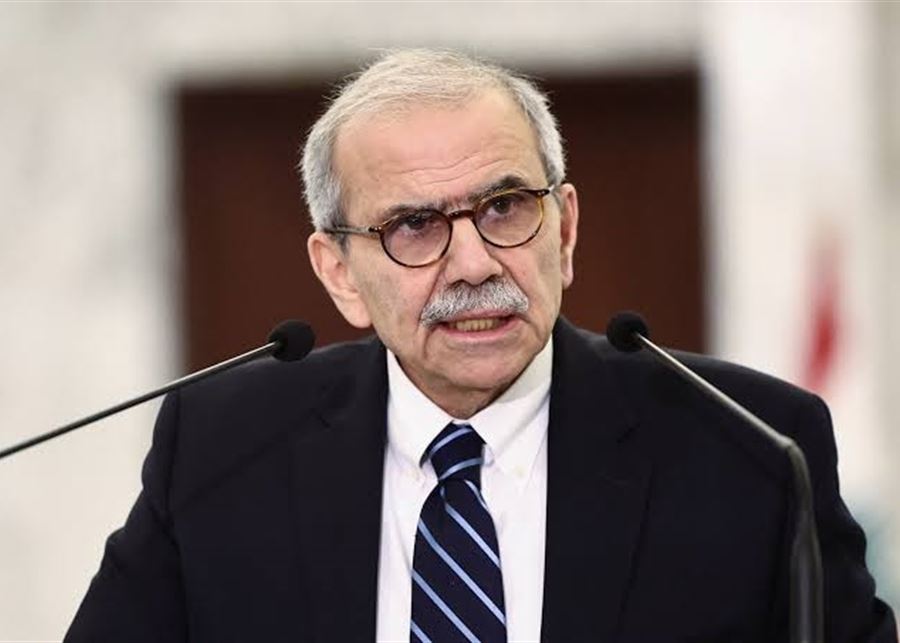
The media office of Minister of Energy and Water Joe Al-Saddiy issued the following statement:
Former Minister of Energy Walid Fayad published an article titled "The Electricity Plan for Random Deregulation: The Dangers of Chaos, Quota-Sharing, and Lack of Competitiveness" in the Tuesday, August 18, 2026 issue of the newspaper "Al-Akhbar", which contained numerous fallacies regarding the "Electricity Sector Policy" paper approved by the Council of Ministers on July 23, 2026, and its relationship to previous sector policies.
This paper is an integrative step with the positive points and a corrective one for the negative points in previous papers approved for the electricity sector, including the 2022 paper drafted by Fayad, stemming from the concept of cumulative institutional work believed in by Minister of Energy and Water Joe Al-Saddiy. However, it seems Fayad has grown accustomed to "policies of cancellation" based on each new minister nullifying the work of their predecessors and starting from scratch. It also seems he forgot or overlooked the contents of his own 2022 paper, which intersected at several points with the 2026 paper, yet he did not spare these points from his criticisms for purposes that have become exposed to the Lebanese people.
Therefore, to prevent Fayad’s article from creating any confusion or misleading the public, we present several clarifications, particularly regarding the nature of the electricity sector policy paper approved by the Council of Ministers, the vision of the current Ministry of Energy and Water, and Law No. 462/2002.
The Current Policy Paper and Previous Policies
It is important initially to place the current policy paper in the context of the policies that preceded it. Reforming the electricity sector is a cumulative path, and this paper does not cancel previous policies; rather, it improves or corrects them where necessary and complements them in a specific aspect primarily related to sector structure and organization, the transitional model, and the long-term model.
Previous policies, notably the 2010 and 2019 plans, and then the electricity sector policy statement approved by the Council of Ministers in March 2022 under the title "Setting Lebanon’s Electricity Sector on a Sustainable Growth Path," addressed a wide range of issues related to restoring power supply, increasing generation capacities, renewable energy, securing gas, rehabilitating grids, improving distribution and revenue collection, financial sustainability, and institutional reform.
Among what the "2022 Policy" paper included was the establishment of new generation capacities and public-private partnerships in generation and distribution.
As for the 2026 paper, its subject matter is different. It does not redefine the capacities mentioned in a previous plan, but rather addresses in greater detail how to organize the sector itself: the role of the Electricity Regulatory Authority, transforming Electricité du Liban into a company, the gradual unbundling of activities, organizing generation, transmission, and distribution functions, and the Single Buyer during the transitional phase, along with the conditions for subsequently transitioning to the long-term model.
The Single Buyer and the transitional phase are not newly invented concepts in the 2026 paper; the Ministry had already adopted them originally within its previous policy approved by the Council of Ministers in 2022.
What About Generation and the Energy Mix?
The 2026 paper's failure to specify the number of plants, their capacities, or the future energy mix does not mean the issue of generation has been neglected. The current paper is not a generation plan. It explicitly stated that the Ministry of Energy and Water is working in parallel on preparing the Least-Cost Generation Plan with the Electricity Regulatory Authority and Électricité de France (EDF), funded by the AFD, which will form the strategic basis for future expansion in generation and investment.
This plan will determine, based on current sector data, the new capacities required, the optimal mix among various energy sources, the timing for introducing these capacities into the system, taking into consideration cost, supply security, system flexibility, and grid requirements, with its outputs to be submitted to the Council of Ministers according to established procedures.
The Current Ministry's Vision is Broader than the Policy Paper
The policy paper cannot be read in isolation from the vision of the current Ministry of Energy and Water. The Ministry has defined seven interconnected and complementary tracks for reform, including increasing conventional generation capacity, increasing renewable energy generation capacity, transitioning to natural gas, enhancing electrical interconnection with neighboring friendly countries, rehabilitating the transmission grid, reorganizing the distribution network, and institutional reform. The vision also independently includes the rehabilitation of the transmission grid and modernization of the National Control Center, and the reorganization of the distribution network while determining the most appropriate model for it. Consequently, generation, transmission, distribution, and grid rehabilitation are core dossiers in the reform workshop being worked on. The policy paper is one component of a broader reform vision, not the entire vision.
Conventional Generation and Distributed Renewable Energy
As for the distinction made in the article between conventional generation and distributed renewable energy, it is natural that the nature of projects, market mechanisms, and regulation differ between the two.
Law No. 318/2023 established a special framework for distributed renewable energy, allowing for multiple producers and prosumers and opening the field to advanced models that allow for competition and prevent monopoly. In distributed renewable energy, there can be a large number of small and medium producers. As for large generation projects, competition is achieved through competing Independent Power Producers (IPPs).
This is also not a new direction. The 2022 policy itself stipulated private sector participation in increasing generation capacities, and the implementation of public-private partnerships in the generation and distribution sectors.
Furthermore, the 2026 paper clearly states that generation during the transitional phase is provided from existing generation assets alongside IPPs, imported electricity, distributed energy resources, and the possibility of selecting IPPs through competitive and transparent procedures in accordance with the applicable legal framework.
Law 462 and Its Implementation
From a legal standpoint, Law No. 462/2002 remains the primary applicable framework for organizing the electricity sector, and the policy paper itself stipulates that it is applied fundamentally within the framework of Laws No. 462/2002 and No. 318/2023, with any legislative amendments that may become required to be addressed through the competent legislative track.
At the same time, the application of the law does not mean it cannot be developed. The Ministry has already begun working on amendments that may be required to Law 462 in coordination with the relevant parties, a path explicitly stated within the current Ministry's plan.
The Transitional Phase
Transitioning directly from the current situation to a fully deregulated electricity market presupposes the existence of the necessary prerequisites for the functioning of such a market, which are incomplete today. Therefore, there is a need for a transitional phase that responds primarily to the current reality of the sector and the absence of the conditions necessary for an immediate transition to a fully competitive market.
This phase does not mean suspending the application of Law 462 or creating a parallel legal framework to it, but aims to establish a gradual path for implementing the targeted sector structure within the applicable legal framework. In this context, Article 47 of Law No. 462/2002, under the heading "Details of the Application of the Law," states that "the details of the application of this law shall be determined by decrees taken in the Council of Ministers upon the proposal of the Minister."
As long as the law established the basic framework for the sector and left the determination of the details of its application to decrees taken by the Council of Ministers upon the proposal of the Minister, the adoption of executive and transitional arrangements does not in itself constitute a departure from the law or an amendment to it. The paper defines the direction and the path, while whatever requires decrees, decisions, or regulatory bylaws is issued by the competent authorities and in accordance with established procedures.
The Single Buyer
The Single Buyer is proposed as a transitional mechanism and not the final market model. Here it is important to return once again to the 2022 policy. That policy explicitly stipulated the establishment of a transmission system operator and the adoption of a single buyer during a transitional phase who buys from electricity producers in both the public and private sectors, leading subsequently to a deregulated and organized electricity market. Consequently, the 2026 paper does not invent this model, but rather defines in greater detail how to organize it within the proposed institutional structure.
Moreover, Law 462, even though it did not literally stipulate an entity called the "Single Buyer," granted in Article 28 a central role to the transmission company in the relationship between generation and distribution, as it stated:
"The transmission company shall work to meet the requests of generation and distribution companies to wheel the produced and required power determined by the Authority based on various energy sources. The transmission company shall ensure the continuity of supplying consumers with electric power [...] and shall also coordinate between generation and distribution companies."
This text provides for a central role in coordinating between generation and distribution and ensuring supply continuity. In the first phase, the Single Buyer function is exercised through a department within the transmission directorate in the public company, to be unbundled later into an independent entity in accordance with the stages of sector restructuring.
The 2026 paper separated the technical transmission function from the commercial wholesale purchasing function.
TRANSCO handles the operation of the transmission network, dispatch, balancing, and non-discriminatory access, while the Single Buyer handles the wholesale purchasing function during the transitional phase. Consequently, the Single Buyer is not proposed as a substitute for the competitive market, but as a transitional mechanism until the conditions for transitioning to the long-term model are completed.
Conclusion
When reading sector policies, it becomes clear that the 2026 paper came to improve and apply what preceded it within an integrated institutional framework, and everything criticized regarding the "Single Buyer," the "transitional phase," and the application of Law 462 was previously stated.
In conclusion, the foundation remains not only the drafting of papers but their transparent and serious implementation—something Lebanon suffered from throughout the past years during which Fayad’s political team ran the Ministry, to whom the saying applies: "Hear [it] and you rejoice, try [it] and you grieve."
← Previous article
After his hunger strike... Riad Salama was transferred to Dahr El-Bachek Hospital
Related Articles
Operating without a license... closing a slaughterhouse in Beirut with red wax
Salam: Public transportation touches the life of every citizen... and a painter reveals a network of 54 routes and 300 buses
New fuel schedule... How much were the prices?