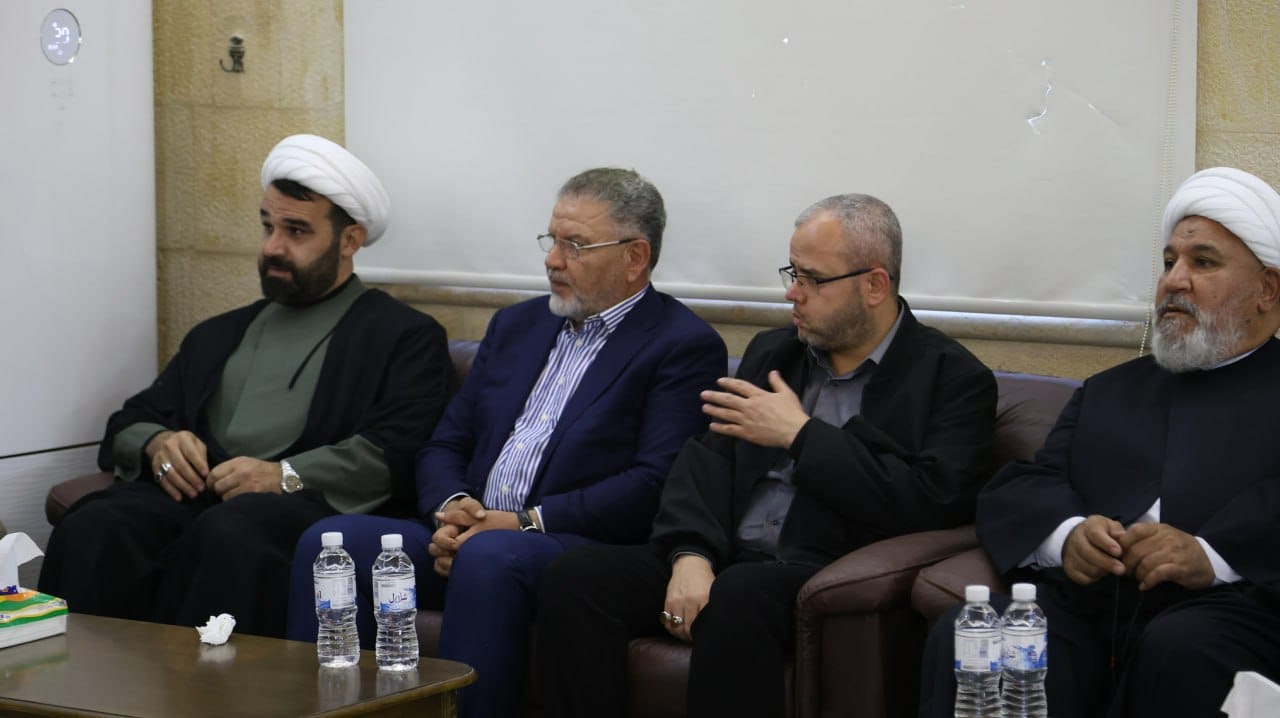
Basil: The Israelis are responsible for the destruction
12:59 · 09 May 2026
12 min read

Head of the Free Patriotic Movement, MP Gebran Bassil, pointed out that "Christians have a role in Lebanon, in this region, and in the world, as they are a bridge connecting sects and a message of hope, love, peace, understanding, and acceptance of the other," noting that "coexistence is a model for society that is best embodied in Lebanon."
In an interview with the American platform "CDM", he considered that "were it not for the presence of Christians in this region of the world, the message of Christianity would have been lost; therefore, this place where Christians exist is an ideal place where Christians can spread their message, which is the message of Christ," pointing out that "they can prove that people can live together despite their differences in ideologies, religion, and the wars that contradict our message."
He pointed out that "we are struggling for a better life, for freedom, for hope, but we are not struggling to fight, nor are we fighting to eliminate others; rather, we are fighting to uphold our faith and beliefs," noting that "we also accept that others live by their faith and beliefs." He expressed his belief that "if Christians are excluded from the equation in this region, the model of coexistence will neither flourish nor exist, and this is the role of Christians that must be preserved for the sake of humanity, otherwise we will live in endless conflicts."
Bassil added: "The spirit that Christians spread in Lebanon is that such a society can exist. The big question is not about the role of Christians, but rather whether Christians will be allowed to play this role alongside a state like Israel, and whether the United States of America will support and back this role played by Christians in Lebanon and the region."
He considered that "all the wars that Lebanon and the region are going through negatively affect Christians, their presence, and their role, because whenever you provoke and encourage conflicts between sects and religions, the voice of war will be louder than the voice of peace, and the message of Christians will have a marginal role."
He pointed out that "whenever there are wars, moderate people will have a marginal role," asking, "Is this why we live in continuous wars, or does it allow us, even encourage us, to play our role in spreading tolerance, because this region is a land where religions were born, and therefore we either fight endlessly until one of our gods triumphs and each one has his own theories—one of them will have to wait for the coming of the Mahdi to Jerusalem, another will await the Antichrist, and the third party will await the true Christ, and based on that, each one is allowed to have his creed, but without preventing the other from practicing his own creed."
He added: "Must we practice this by fighting each other, or for example, do we accept that Jerusalem is a city open to everyone, and each one can await his savior alone at the time he chooses and according to his own theory?"
Regarding the decline in the number of Christians in Lebanon and the impact of the presence of displaced persons on its demographics, Bassil considered that "the number of Christians is not only decreasing in Lebanon, but in the Levant as a whole," pointing out that "the number of Christians in Iraq used to be two million, and now they are perhaps less than 200,000, while their percentage in Bethlehem is less than 8%, and even if they want to hold an Easter mass, they have to go through a major struggle with the Israelis." He explained, "In Syria, their number was two million, which is more than 10% of the population less than ten years ago, and now they are certainly a quarter of that number, and the dream of every Syrian in Syria has become emigration."
He continued: "In Lebanon, we were the majority and now we have become the minority, and here the responsibility falls on us in a way," stressing that "it is a demographic responsibility, but it is also because of the political situation, as people emigrate because they do not find a place here for their ambitions, but also for their freedoms, and they do not find support for that, so they believe that this region is no longer suitable for us to spread our message freely. Every time a war breaks out in this region—and unfortunately, whether it was a war supported or launched by Western countries—it comes at the expense of Christians."
Bassil stressed that "Christians are the ones paying the price for wars and conflicts, and for this reason, we want to make Lebanon neutral so that it plays a positive role in bringing people closer together, not be a source of conflicts in the region, and not be forced to take sides with one party against another, as fighting does not help us spread our message, but rather drives us to leave."
He added: "I do not think the West needs an additional million or two million Christians; they have enough Christians in the United States, in Europe, and everywhere, but they need us in this region to preserve our message, as well as to preserve the possibility of coexistence, because if they cannot live together here, how can they live together in the United States of America?"
He said: "Christians can be convinced to return to Lebanon by giving them confidence that this place is livable, where they can express their freedoms and have an active role not only in life, but in politics as well, because Christians will never settle for just living in luxury; they must also exercise their role," pointing out that "Christians cannot be passive in society, and the more passive they are, the more they leave."
Bassil touched upon what is happening in the South, pointing out that "the Israelis are not protecting any community in this war; rather, they are attacking everyone, killing everyone, destroying, and carrying out the complete destruction of homes. Christians and Christian villages ultimately want to live with their neighbors," stressing that "they can live in peace with Israel, but they also need to live in peace with the rest of the Lebanese, Muslims, and their neighboring villages."
He stressed that "Christians must be allowed to remain in the villages of the South, because if they leave, it will not be easy for them to return," adding, "Their homes have been demolished or occupied by Israeli forces, and their dignity has been violated in the way this is being done. One day you see Christ and another day you see the Virgin Mary in a bad state—and we are talking about statues, the demolition of churches, and others."
He pointed out that "we are talking about several cases, and a soldier can commit a sin, and this could be an individual mistake or a 'slip,' but when Israeli forces deliberately destroy more than ten churches, what is the message they are promoting?" He added, "They consider or promote the idea that Shiites are the source of terrorism or danger to their soldiers, but during a truce and when there is a ceasefire, how can a church be a source of danger to the Israeli army?"
He stressed that "Hezbollah poses a problem because, unfortunately, it has recently been operating according to the Iranian agenda and does not have the approval of the Lebanese people or the legitimacy from the Lebanese government and authorities to act alone, so the party bears a specific responsibility for what is happening now."
He continued: "However, the Israelis are responsible for the destruction and the peaceful solution, as there must be a cessation of hostilities from the Israeli side and then a withdrawal of their army, and from the Lebanese side, the Lebanese state must be responsible for maintaining stability and peace on the border."
He considered that "all this preparation is for a long-term, fair, and permanent peaceful solution between the two countries, as we believe they can live in peace if the rules and foundations of peace are firm and equal between the two countries," adding, "This is the solution, so we must guarantee Lebanon its sovereignty and freedom, and we must guarantee Israel its security, and Hezbollah's fate can be the result of this solution when we have a Lebanese solution that guarantees the protection of Lebanon."
Bassil considered that "in such a case, Hezbollah will not have any reason or excuse for resistance, because it and Lebanon should not be responsible for liberating Palestine; rather, the Palestinians should be responsible for liberating their country," pointing out that "whenever Hezbollah goes outside the Lebanese context, it loses the war and the ability to defend Lebanon, and loses trust and legitimacy from the Lebanese side."
He stressed that "we have a vision on how to live in peace internally first, and then with our neighbors second, because we believe in the role of Lebanon, which possesses many advantages in human resources and also enjoys geographical advantages thanks to its strategic location." He explained, "You know that maritime borders, straits, and maritime and water corridors are very important, and Lebanon has a role in connecting communities and cultures, but also between East and West, and in providing a safe corridor for pipelines and trade routes. Therefore, Lebanon must be kept away from conflicts, and our vision to achieve this role for Lebanon is that we can be complementary to the vision we see led by the Kingdom of Saudi Arabia and the Gulf states. From this Mediterranean region, we can be complementary to this vision, within which we must achieve the rights of the Lebanese state, as Lebanon has been subjected to fierce attacks by the Israelis since 1948." He said: "We still have between 400,000 and 500,000 Palestinian refugees in our country, and we still have more than a million or a million and a half Syrian displaced persons, so Lebanon must remain for the Lebanese, and the problems of other countries should not be solved at our expense."
Bassil pointed out that "we need a defense strategy for Lebanon like any other country," explaining, "A strategy adopted by Lebanese institutions and accepted by all Lebanese, which guarantees internal peace among the Lebanese. Then there must be protection from the international community stipulated by United Nations resolutions, through neutrality that keeps Lebanon out of conflict, and through achieving peace and a peace treaty with Israel and the region," noting that "this peace can begin with a truce and then move to peace."
He said: "We can work together in culture, economy, finance, and the arts, and this is the field in which we can compete," asking, "Are we allowed to compete, or are we only allowed to wage wars?"
He continued: "Does the Israeli government or authority accept that Lebanon retains its originality and privileges so that it knows how to play its role in any field? Or must Lebanon always be weak?"
Bassil said: "The absence of Christians from Lebanon will lead to its weakening," adding, "Is this what the country needs? For the state to be weak in the absence of Christians so that the Israelis can control the region? And is this always the goal of American administrations?"
He pointed out that "the United States has a great influence," saying, "We have in Lebanon the largest embassy, the largest university—and I was a student at the American University of Beirut—and we respect American values, democracy, and human rights, and these are our values, so of course we feel connected to the United States in many values, principles, and way of life, but we also want to be accepted in our role and our presence to be preserved."
He noted that "whenever the United States adopts a fair policy, we can reach a just peace."
Regarding talk about the partition of Lebanon, Bassil considered that "the area of Lebanon is 10,452 square kilometers, and Christians are spread all over the country. Let's suppose the country is partitioned; what do we do with the Christians in non-Christian areas? Do we invite them to further emigration? Or do we ask them to leave their homes and come live in small Christian Lebanon?"
He continued: "Small Christian Lebanon will also be surrounded by Muslims, so should we build walls to protect ourselves, and is the role of Christians isolation? Or is their role coexistence with others all over the country and in the whole region? I do not see how we can express our Christianity by isolating ourselves in 2,000 square kilometers, surrounded by other communities and without protection," considering that "partitioning this country is a means to thwart the possibility of living together in Lebanon and in the region, and I believe in other places as well."
Bassil concluded: "What we want from the Americans is to be fair and equitable. We understand their interests in the region. We accept their preference for Israel, but we believe we can be treated equally in a way that allows the United States to truly focus on America first, but also to care for other parts of the world in a fair manner and with an unbiased and acceptable policy," stressing, "I do not think the United States has gained much from weakening minorities in the region or Christians in many parts of the world, and what we want is for them to be fair to everyone."
In this story:
Gebran Bassil

← Previous article
Fadlallah: We will not accept submission to dictates and let the enemy expect our response
Related Articles
Jumblatt: Lebanon-Israel negotiations will not bear fruit as long as Israel occupies the south
Hasbani: The Dahr al-Baidar incident is a gateway to implementing the government’s decisions regarding the party’s weapons
Contact between Al-Hajjar and his Saudi counterpart... enhancing joint cooperation between the two countries