Aoun warns: The hand that extends to the civil peace will be cut off
18:24 · 30 March 2026
13 min read
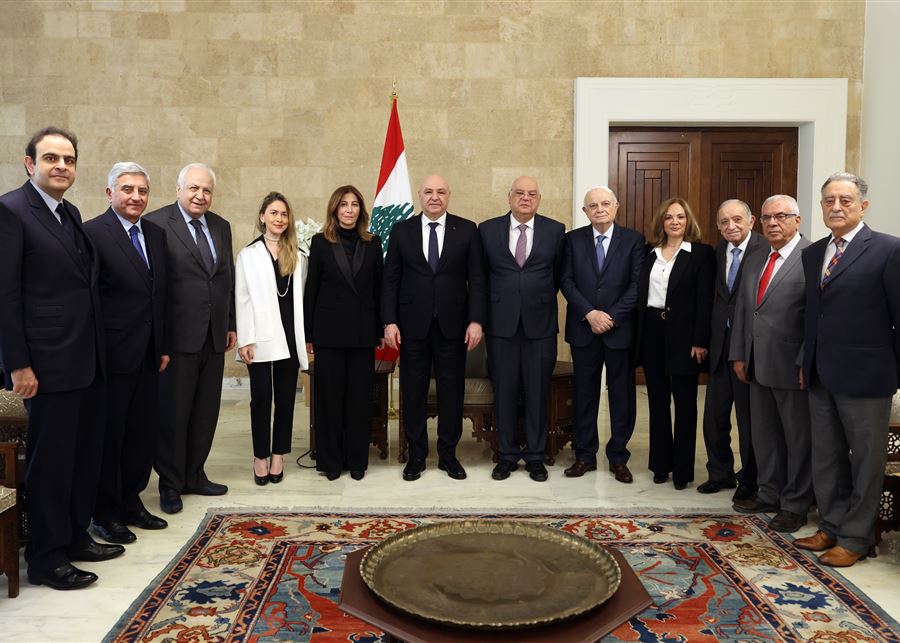
President Joseph Aoun reassured that there is no justification for fearing for civil peace, and that security agencies are taking firm steps to prevent any security disturbance among the Lebanese, carrying out arrests and weapon confiscations.
He said: "The hand that reaches out to civil peace will be severed."
On the other hand, he stressed the continuation of his various international contacts to push matters toward achieving negotiations with Israel.
President Aoun's remarks came during his reception before noon today at the Baabda Palace of a delegation from the Ghassan Skaff National Forum.
At the beginning of the meeting, Mrs. Meisssam Skaff, the widow of the late MP Ghassan Skaff, pointed out that the forum is an initiative launched by Skaff himself before his death, through which he aimed to bring together independent national figures from various scientific, cultural, political, and sectarian backgrounds to be a unifying and national gathering. The forum took his name after his death.
She indicated that the forum aims to form a space for dialogue and convergence, in addition to its members supporting President Aoun's tenure and the steps he is taking.
Salah Salam
Then Mr. Salah Salam read the political statement handed over by the forum to President Aoun, the summary of which is as follows:
"The forum sees in this highly dangerous moment in Lebanon's history, where our homeland has been placed on the brink of an open slide into the unknown, that the growing risks and challenges place the state itself before an unprecedented existential test. Hence, we affirm that the sole gateway to salvation begins with re-establishing the state's authority as the sole legitimate entity authorized to make the decision of war and peace, and ending the duality of security decision-making and multiple centers of power.
Restoring the state's prestige requires strengthening internal security through the deployment of the army and security forces across all Lebanese territory, preventing any armed manifestations outside the framework of legitimacy, and organizing the demographic situation—whether by controlling the conditions of the displaced or organizing the residential sector—as a fundamental pillar in protecting social security, preventing the aggravation of tensions, and preparing to take exceptional measures when necessary to protect the capital and preserve stability. Concurrently, the preventive security system must be developed through the use of modern technology and the enhancement of legal oversight, allowing risks to be anticipated and avoiding falling into the spiral of action and reaction."
He added: "At the political level, the forum affirms that restoring sovereignty requires practical and decisive implementation of the decision to monopolize weapons in the hands of the state, alongside repositioning Lebanon regionally and internationally, activating the government's work, and launching a genuine reform workshop that rebuilds internal and external trust.
In the context of protecting national stability, there emerges the necessity of a complete separation between any military action and the future of the state, launching a serious national dialogue to reorganize political life within the framework of the state and its institutions, and drafting a modern parliamentary election law based on unifying national democratic rules that respect pluralism within the framework of national unity and the formula of co-existence enshrined in the Taif Agreement.
National priorities begin with halting hostilities, ensuring the return of the displaced, launching the reconstruction process, strengthening Lebanon's Arab relations, and safeguarding its sovereignty in the face of all challenges.
Restoring the state is not a choice as much as it has become a condition for Lebanon's survival. It is a historical responsibility that requires clarity of vision, boldness in decision-making, and an unwavering commitment to applying the constitution."
He concluded: "This national constellation, which includes a distinguished elite of intellectuals and opinion leaders, has come to confirm to you that the 'Ghassan Skaff National Forum' supports your wise leadership, the government's bold decisions, and all the principles and executive steps mentioned in the oath of office and the ministerial statement to steer Lebanon out of current risks and gambles."
President Aoun
President Aoun responded by praising the ideas put forward by the forum, touching in his speech on the issue of civil peace in Lebanon and the fears raised by some parties regarding this issue in an effort to refloat themselves. He reassured that there is no justification for fearing for civil peace, and reports from security agencies confirm this. These agencies are taking firm steps to prevent any security disturbance among the Lebanese, carrying out arrests and weapon confiscations, explaining that the problems and friction with the displaced that occurred previously during the Israeli war on Lebanon in 2024 did not happen in the current war.
He stressed that no one in Lebanon wishes for the outbreak of civil war, and that those seeking to fish in troubled waters will not succeed in their endeavors. He said: "The hand that reaches out to civil peace will be severed."
He pointed to the major efforts made by the government to address the dossier of the displaced, through which it achieved rapid and effective absorption of this crisis. He said: "No one takes the place of the state, despite the difficult circumstances and resources we work through." He noted that the government, since its formation, has taken a large number of bold decisions and steps to reform conditions in the country.
President Aoun pointed to the tragic conditions in the south in particular, due to the grave violations committed by Israel, the destruction it inflicts on southern villages and regions, and its disregard for the initiative he put forward regarding negotiations, despite ongoing international mediations. He stressed that he continues to make multiple international contacts to push matters toward achieving negotiations with Israel.
Brigadier General Edde and Lawyer Kanaan
Politically, the President of the Republic discussed the general situation in the country and current political developments with Brigadier General Carlos Edde and the Secretary-General of the Maronite League, Lawyer Paul Kanaan.
Rotary
Additionally, President Aoun received the head of the Water Purification Committee in "Rotary Lebanon," Mrs. Mona Kanaan, and the presidents of Rotary clubs in Lebanon, on whose behalf the president of the Rotary Club of Beirut Cedars, Mr. Ghassan Hajjar, spoke.
At the beginning of the meeting, Mrs. Kanaan spoke, saying: "We visit you as the Water Purification Committee, with whom we have long worked back when you were the Army Commander, to affirm to you the renewal of our activity amid the need of army barracks for this project." She stressed that the visit of the delegation, which includes all club presidents in Lebanon, is to renew support for the tenure and to study ways of cooperation in all fields.
Then Mr. Hajjar spoke, saying: "Lebanon is going through delicate circumstances in which humanitarian and economic challenges intertwine, increasing the need to pool efforts and foster a spirit of shared responsibility. This meeting comes as an affirmation of the importance of dialogue and integration among various parties, serving the public interest and keeping pace with people's aspirations."
He added: "Rotary is founded on a firm system of values, foremost among which is 'Service Above Self,' joint action, and humanitarian responsibility translated into initiatives that directly touch people's lives in society, the workplace, and across the world. From this standpoint, Rotary upholds a mission based on humanitarian service, encouraging high ethical standards in various professions, and contributing to the entrenchment of goodwill and peace.
This mission is also manifested in Rotary's major projects worldwide, foremost among them the 'PolioPlus' program... the most prominent program launched by Rotary since 1985 to eradicate polio in partnership with international bodies such as the World Health Organization and the Gates Foundation. This effort has contributed to reducing disease cases by more than 99.9 percent globally, in a clear model of what joint will can achieve when coupled with continuity and belief in action.
He continued: "Rotary clubs in Lebanon, in all their components and through their clubs spread across the country, have worked in close cooperation with the 'Lebanese Food Bank' and the 'Mon Liban d'Azur' association to launch humanitarian initiatives aimed at supporting the most needy groups. In this context, Rotary is proud of its cooperation with the 'Lebanese Food Bank' to deliver food aid to displaced families of soldiers, an initiative by its president, Mona Kanaan, and in cooperation with the First Lady—an initiative embraced by this edifice, in an indication of the integration of efforts to serve those bearing the burdens of this stage. During the crises related to displacement, the 37 clubs were present on the ground contributing to relief, securing food and clothing, and creating spaces of humanitarian and social support for families, reflecting a cohesive collective spirit that bore responsibility effectively.
This role was not limited to the current crisis; since the years of the pandemic, Rotary in Lebanon has accompanied the harshest milestones, from securing ventilators and food aid to contributing to the restoration and re-equipment of four hospitals after the Beirut port blast tragedy, in a response that embodied the presence of the clubs combined in moments when the country was in dire need of those to stand by it.
Today, with the renewal of the crisis, this commitment continues with greater momentum and doubled energy, as more than $100,000 has been raised and allocated to support the displaced, with continuous support from Rotary clubs around the world, especially those led by members of the Lebanese diaspora abroad—support that expresses Lebanon's solidarity and also confidence in Rotary's mission in its ability to turn initiative into impact."
He concluded: "At this sensitive stage, the role of Rotary based on initiative and service intersects with the role of the Presidency of the Republic as a unifying and responsible reference for safeguarding national interest. This intersection contributes to enhancing opportunities for joint work, reinforcing trust, alleviating burdens on people, and paving the way for steadier steps toward a stage where the Lebanese need a true partnership that restores hope."
President Aoun
President Aoun responded by welcoming the delegation, praising the efforts of the Rotary clubs and their support for the military institution, particularly through the water purification project alongside other projects. President Aoun said: "It is our duty, together with you, to serve the Lebanese people and our displaced families, especially in light of the difficult circumstances this country is passing through. You have always been and continue to be leaving a mark within Lebanese society at every stage where the citizen is in dire need of the help and love of his fellow Lebanese," speaking in this context about the current war and recalling the milestones of the Beirut port blast, the COVID-19 pandemic, and the 2024 war.
President Aoun said: "Serving humanity is a continuous work that does not end with the end of circumstances, and it represents the highest degrees of humanity away from selfishness, especially when it stems from the heart and absolute conviction. Herein lies the strength of the Lebanese people, who serve one another in the heart of crises."
Delegation of the Border Town of Debel
President Aoun received a delegation from the border town of Debel, on whose behalf the mayor, Mr. Akel Naddaf, spoke, presenting the reality currently experienced by the town, and saying:
"We thank you, Mr. President, for receiving us today in light of these difficult circumstances our country is passing through. Our visit today aims to convey the true picture of what is happening and what we are suffering in our town of Debel. With the beginning of the war, all roads leading to the town became cut off due to danger, except for the Debel-Rmeich road, which remained passable almost normally, ensuring the entry of aid into the town until the Israelis advanced and stationed themselves on the outskirts of the town and in the outer neighborhoods, including this road, causing it to be cut off. Thus, we became in complete isolation from the world—no medicine, no foodstuffs, no water, as the stationing is at the artesian well site, making it impossible to reach to operate the pumps, especially with the complete cutoff of drinking water. The residents, numbering about 1,700 people, have come to live a real daily suffering, which forced the residents to risk their lives and take the Debel-Rmeich road at their personal responsibility to obtain medicine and other things to save their families. Four days ago, a wounded person from among us miraculously survived with his family after the shelling of his house located on this road. Yesterday, two martyrs fell from among us on this road as well, in addition to Father Pierre Al-Rai, the parish priest of Qlaiaa from Debel. It is as if our destiny in every war is to pay the price of our steadfastness with blood to preserve our land in wars we have nothing to do with. We are steadfast on our land no matter how harsh the circumstances get; if we are displaced, we might lose our land forever.
While expressing our people's steadfastness and attachment to their land, we place before you the needs of our steadfast people, which include:
- Securing a UNIFIL patrol to enter the town to accompany the entry of aid and residents.
- Securing a Red Cross vehicle in the town, as the existing dispensary is unable to meet the needs of the patients and the injured.
- Securing access to the artesian well to ensure water is pumped to the residents."
President Aoun responded by promising the delegation to follow up on the demands they presented, focusing on the importance of the southerners' steadfastness on their land and property while taking the military situation into account.
The delegation included, in addition to the mayor, Messrs: Hanna Hannoun, Massoud Naddaf, Jad Naddaf, George Younis, Youssef Younis, Fares Hanna, Nassim Nassif, Joseph Naddaf, and Walid Nassif.
UNIFIL Condolences
On another note, President Aoun contacted before noon today the Commander of the United Nations Interim Force in Lebanon (UNIFIL) in the south, General Diodato Abaniara, and offered his condolences on the martyrdom of the Indonesian soldier who fell as a result of his position in Adchit al-Qusayr being shelled, which also led to the injury of another soldier.
President Aoun renewed his condemnation of attacks on peacekeeping forces operating in the south, wishing a speedy recovery to the wounded soldier and praising the sacrifices of the international soldiers serving in UNIFIL in southern Lebanon.
In this story:
Joseph Aoun
← Previous article
The Foreign Ministry condemned the killing of a soldier: an unacceptable attack
Related Articles
Jumblatt: Lebanon-Israel negotiations will not bear fruit as long as Israel occupies the south
Hasbani: The Dahr al-Baidar incident is a gateway to implementing the government’s decisions regarding the party’s weapons
Contact between Al-Hajjar and his Saudi counterpart... enhancing joint cooperation between the two countries