On the sixth anniversary of August 4, the Port of Beirut renews its loyalty to its victims
19:01 · 04 August 2026
10 min read
The Port of Beirut Management and Investment, in the presence of Minister of Economy and Trade Dr. Amer Al-Bissat and Minister of Public Works and Transport Fayez Rassamni, marked the sixth anniversary of the martyrdom of port workers who lost their lives in the August 4, 2020 explosion. The ceremony was held within the port premises with the participation of Chairman of the Board and General Manager of the Port Marwan El-Naffi and its board of directors, Container Terminal Director Charlie Darzi, the Customs administration, representatives of security agencies operating in the port, unions and bodies operating and dealing with it, alongside the syndic, secretary, and members of the Port of Beirut Employees and Workers Syndicate, the port family, and the victims' families.
The ceremony began with a minute of silence observed for the souls of the port victims, followed by speeches delivered on the occasion.
Minister of Economy Dr. Amer Al-Bissat said: "On August 4, 2020, the heart of Beirut broke. Martyrs fell from every home and every neighborhood. A day that time will not fold away. A day that left a wound in the memory of the Lebanese that will never heal, even if its pain has lessened with the passage of years.
On this day, we remember the victims, stand in solidarity with the wounded, and bow before families who lost loved ones and are still awaiting truth and justice."..
He added: "We remember with all loyalty the workers of the grain silos who were at their posts performing their duty. They were not looking for heroism, but they departed while guarding the livelihood of the Lebanese.
Workers whose name will remain part of the memory of this homeland, and a testimony that heroism is often silent, and that the greatest sacrifices are made in the performance of duty.
We also remember the port workers and employees, the martyrs of the Beirut Fire Department, the martyrs of the medical sector, nurses, and every family touched by this disaster.
We also remember foreign workers of various nationalities who were killed in the place where they were searching for their livelihood."..
He concluded: "August 4 is not merely a memory, but also a pledge to build a state that respects the lives of its citizens and respects the lives of those arriving in it. And a pledge to build a state that holds the negligent accountable, and places human safety above all considerations. A state where institutions are a source of protection, not a source of fear.
May God have mercy on all the martyrs, inspire their families with patience, and protect Lebanon from every tragedy. Perhaps the best tribute to those who departed is to insist that accountability and justice come for the victims, and to work so that the future of this country is safer, more just, and more dignified."
For his part, Minister of Public Works and Transport Fayez Rassamni considered that this anniversary continues to represent an open wound in the conscience of the Lebanese, deeming that justice remains an indispensable necessity, yet preventing the recurrence of the disaster requires getting to the root of the problem and addressing it, foremost among which are mismanagement and negligence.
Rassamni began his speech by invoking mercy for the martyrs, extending condolences to their families, and paying tribute to the wounded, many of whom are still paying the price for the explosion to this day, saying: "May God have mercy on all the martyrs, and give patience to their families. I also ask God to strengthen and give patience to the 'living martyrs' who are still among us today, but many of them suffer from disabilities. There is a woman who, to this day, after six years, is still in the hospital."
He added that he still asks himself, as a citizen before being a minister, what the Lebanese have done over the past six years, pointing out that the Beirut port explosion was one of the largest non-nuclear explosions in the world, and that the presence of the silos and divine providence prevented an even greater disaster, otherwise the number of victims would have far exceeded 263 martyrs and about 7,000 wounded and injured. He stressed that everyone who was present in Beirut that day could have lost a family member or been among the injured, saying: "In one second, any human being's life can change."
Rassamni affirmed that everyone is demanding the uncovering of the truth and the completion of the investigation, which is imperative, but he stressed that this alone is not enough to address the root of the problem, saying: "Let us assume that the investigation has concluded, and some ninety accused have gone to prison... It is true that this may alleviate some of the anger of many people, but will we have solved the problem? I tell you, from my position of responsibility, that we will not have solved the problem, because no one has thought about its essence."
He explained that what he has discovered since assuming the Ministry of Public Works and Transport confirms the existence of severe mismanagement and major negligence, adding: "There may be something else, but what I have discovered and assure you of is the existence of very significant mismanagement and negligence."
He pointed out that this was the focus of the discussion with the Chairman of the Board of Directors of the Port of Beirut, Mr. Marwan El-Naffi, and the board members, to understand the reasons that led to the catastrophe and work to prevent its recurrence, not only in the Port of Beirut, but in everything related to the safety of citizens.
He noted that the government has taken several steps since its formation, but it cannot accomplish the required reform alone, considering that a large part of the problem lies in laws dating back to the 1950s and 1960s, which now require a comprehensive review to allow for more transparent and effective management. He added that Lebanon, at every crisis, has grown accustomed to issuing new decisions instead of reforming existing laws, which has led to an accumulation of administrative complications and difficulty in decision-making.
Rassamni addressed the reality of the Port of Beirut administration, asking: "If a smaller explosion were to occur today, who bears the responsibility? To this day, I cannot answer this question." He explained that the multiplicity of concerned authorities and agencies leads to an overlap in responsibilities, with each party shifting blame to the other, considering that this problem has not yet been addressed, and it is among his priorities alongside the Chairman of the Board, the board members, and the General Director of Land and Maritime Transport.
He stressed that the goal is not limited to addressing the aftermath of the explosion or appointing new officials, but goes beyond that to addressing the core of the problem, saying that "this is a great pain, and this is a wound that has not yet healed, and will not heal unless we take the correct measures and decisions." He added that work is still ongoing, and that "to this day, we have not yet taken all the decisions and measures that guarantee such an event will not happen again, but we are working on them."
Regarding appointments, Rassamni affirmed that the government has adopted a mechanism based on competence and merit, pointing out that, on a personal level, he has not appointed any official except after subjecting them to interviews and studying their professional file, without allowing any party to interfere. He said: "We want competent people, not weak people who can be controlled."
He added that whoever knows of violations affecting the security and safety of citizens and remains in their position without assuming their responsibilities or taking the appropriate stance bears part of the responsibility in turn, considering that this was one of the aspects of failure in the previous phase.
He affirmed that the Ministry of Public Works and Transport, in cooperation with the government, has taken decisions he described as "bold" to enhance the security of the Port of Beirut and the security of Rafic Hariri International Airport, yet reform will not be complete without updating the regulating laws, calling for support for this path, and saying: "I will raise my voice as much as possible, and I want you to raise your voice with me, so that we can update the laws, manage according to sound foundations, and reach the required results."
Rassamni criticized the resort of some officials to shielding themselves behind sectarian affiliations when held accountable, revealing that he raised this issue directly with the concerned authorities, and informed them that he would make the decision if one was not taken, noting that he sensed responsiveness in this framework.
He added: "Anyone who hides behind their sect is a weak person." He expressed his view that raising sectarian objections whenever measures are taken against a specific official often reflects the fear of certain beneficiaries from accountability.
Rassamni concluded by affirming that the government, with the support of His Excellency the President of the Republic and Prime Minister, is proceeding with every decision that would protect citizens and enhance the safety of public facilities, saying: "Every decision of this kind that we must take, we will take."
He concluded his speech by invoking mercy for the martyrs, wishing patience for their families, and expressing his hope that the Lebanese will witness more reformist decisions next year that enhance safety and accountability and prevent the recurrence of such disasters.
Chairman of the Board and General Manager of the Port of Beirut Marwan El-Naffi recalled in his speech the first day he assumed the stewardship of the port's administration, affirming that the memory of this date has constituted from the outset an obsession, a responsibility, and an incentive to work in order to honor those who lost their lives in the port.
He said: "From the first day we assumed this stewardship, August 4 was present at the core of our responsibilities. Not because it is a painful memory or a responsibility we bear, but because it was the primary motivation that guided our work, out of loyalty to our colleagues who perished while performing their duty in defense of their institution, their port, and their city."
He added: "The highest forms of sacrifice are for a person to lose their life while at their work site, attempting to protect their colleagues, their institution, the port, and Beirut. To all of them, all appreciation and loyalty, and for their sake we continue working to rebuild a port worthy of their sacrifices and preserving their memory."
He pointed out that the port administration was aware from the moment it assumed its responsibilities that the memory of August 4 would remain present every year, and that the best tribute to those who departed is through reviving the port and restoring its role and status. He said: "We, as an administration, board of directors, and all employees in the Port of Beirut, are working to rebuild this vital facility and return it to the standing it deserves, in loyalty to the memory of our colleagues we lost. Nor can we forget all the victims of the Port of Beirut explosion; their memory remains the incentive that drives us to continue on the path of recovery and revival."
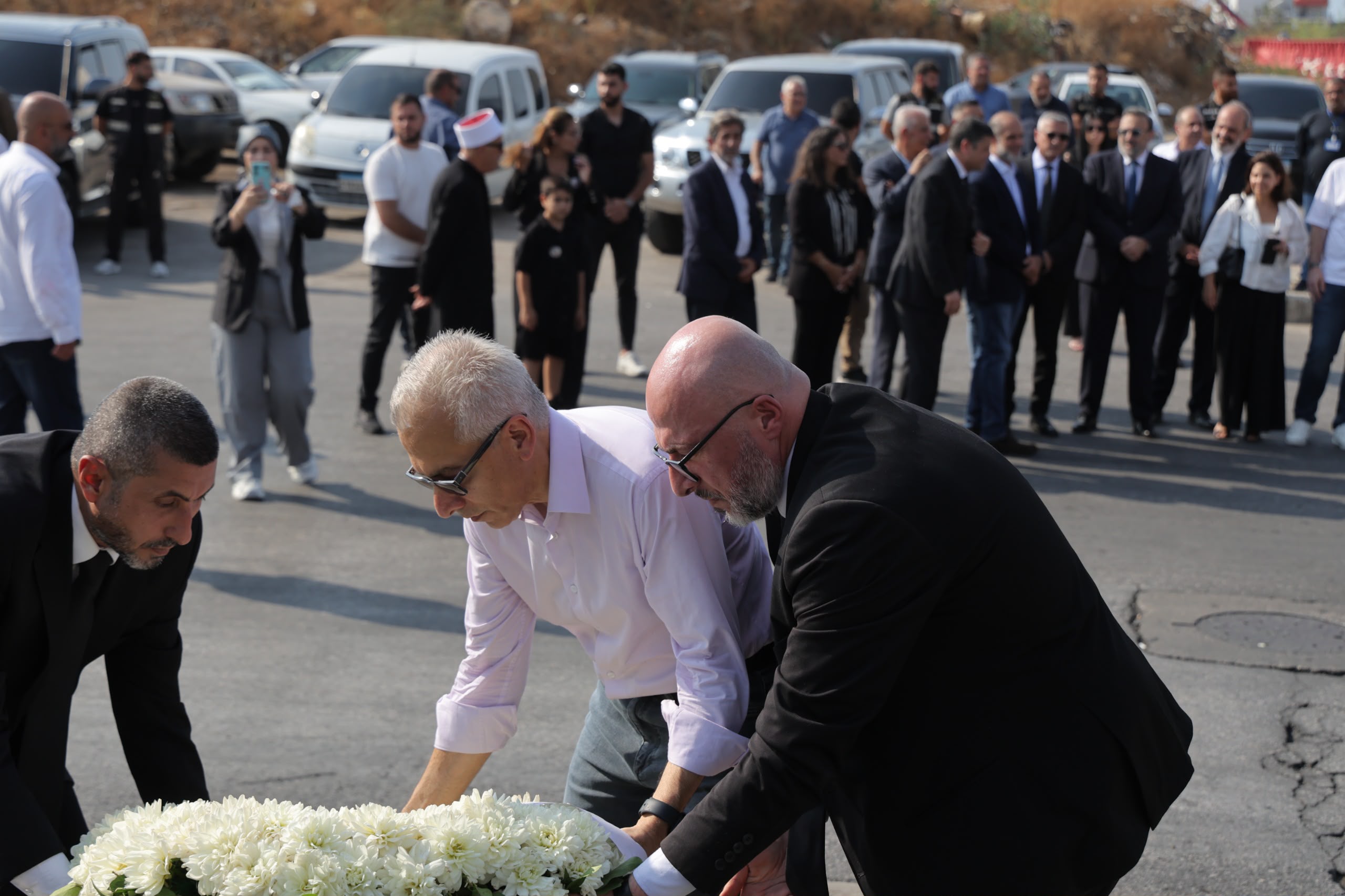
The ceremony concluded with the laying of wreaths at the memorial in the name of the Minister of Economy and Trade, the Minister of Public Works and Transport, the Port of Beirut Management and Investment, the Customs Administration, and the port family.
More from:
Beirut news
← Previous article
Bouassi: Anyone who procrastinates in revealing the truth is a criminal
Related Articles
Jumblatt: Lebanon-Israel negotiations will not bear fruit as long as Israel occupies the south
Hasbani: The Dahr al-Baidar incident is a gateway to implementing the government’s decisions regarding the party’s weapons
Contact between Al-Hajjar and his Saudi counterpart... enhancing joint cooperation between the two countries