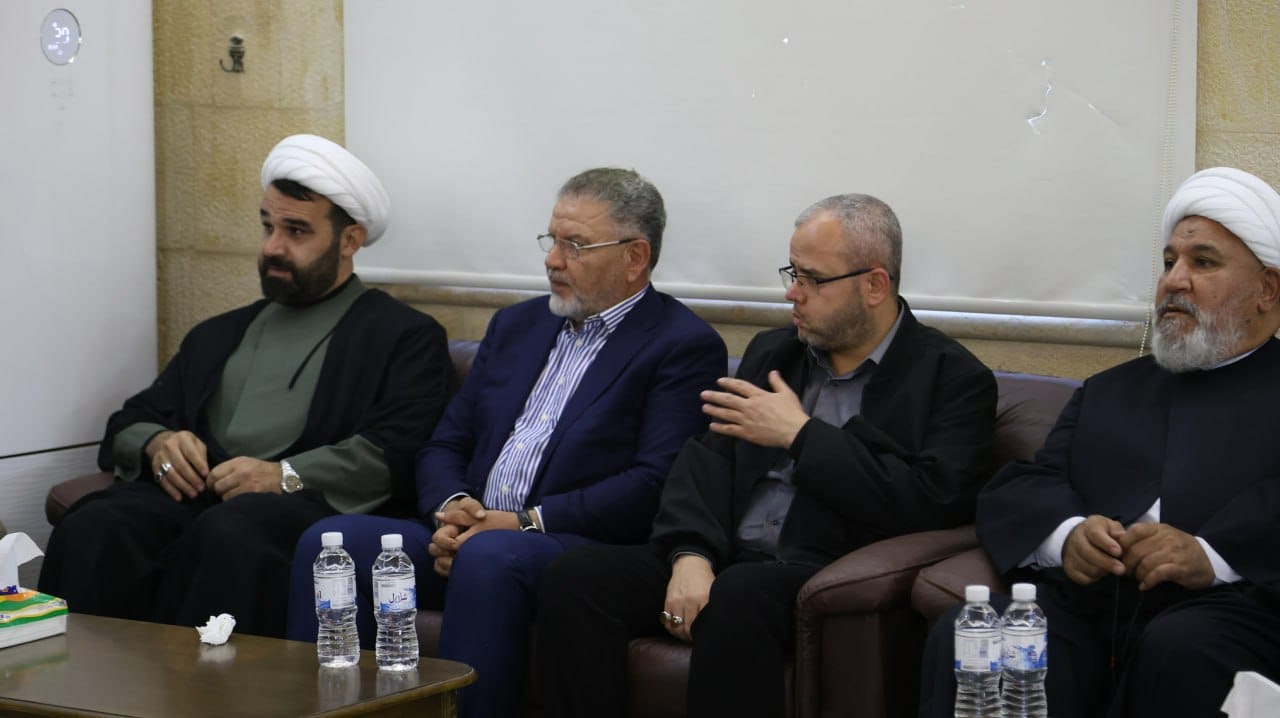
“Lebanon is neither a bargaining chip nor an area offered for concessions.” Bassil: It is time to move from crisis management to creating the future.
13:59 · 30 July 2026
5 min read

Head of the Free Patriotic Movement, MP Gebran Bassil, indicated during the "Protecting Lebanon" meeting held at the Phoenicia Hotel with the participation of parliamentary blocs and various political, economic, and intellectual figures, that "today we meet around a national goal titled 'Protecting Lebanon,' and 'we meet on a paper of constants that we prepared and consulted on for four months and agreed upon, to announce through it our adherence to Lebanese foundations that preserve our unity and gather us in our homeland, and affirm that the state is our choice.'"
He added: "We meet not to declare a front or a permanent meeting or to form a coordinating framework, but to declare that our common goal is to protect Lebanon and strengthen its state through the exclusivity of its decision and arms, its responsibility for preventing strife, and ensuring sovereignty and independence away from any occupation or tutelage."
Bassil continued: "We meet not to be in an eastern or western axis, but for Lebanon to be our axis and its interest above any interest, walking together with everything that liberates its land, whether a tripartite negotiation that restores our sovereignty over our land, or a bilateral understanding that does not touch our independence and does not allow anyone to speak in our name or at our expense."
He added: "We meet in the year of the constitution's centenary, and at the time of the beatification of the 'founder of Greater Lebanon,' Patriarch Elias Howayek, to say that the experiences of more than a hundred years have proven that the weakness of the state protects no one, that its absence opens the way for chaos rather than freedom, and that the loss of diversity does not enhance it but threatens it, and does not preserve sovereignty but exposes it to violation."
Bassil affirmed that "no faction has profited from the collapse of the state, and no group, no matter how strong, will be able to take its place," considering that "Lebanon is not merely a geographical patch, but a homeland, an idea, and a message founded on freedom, diversity, and openness."
He stressed that "the idea of Lebanon is unique and distinctive, but it only endures through a fair and strong state that monopolizes legitimate force and enforces the rule of law, and here we converge on this state," affirming that "our meeting is an open invitation for all Lebanese to renew their confidence in the state, and make the republic the common denominator that rises above any division. The state is not an adversary to any component within it to be feared by it, but rather the sole guarantee for all components, and we must all trust it."
He stressed that "the choice of the state is not a choice among several choices, but rather the condition that makes all other national choices available. And the Lebanese Army, on its holiday today, is the pillar of defense for this state," considering that "building statehood is not a passing stance that is issued, but a national path in which trust accumulates, wills converge, and the public interest precedes sectoral interests, hence our communication today is necessary to consolidate understanding around these constants."
Bassil pointed out that "the Lebanon we want is not a homeland where one faction triumphs over another, but a homeland where the state triumphs over chaos, the law over favoritism, and citizenship over sectarianism," affirming that "there is no homeland without a state, no state without strength, and the state cannot recover its strength except by the will of its people." He added: "We want a state that protects everyone, from without and within, where no group exerts dominance through the outside, and where no Lebanese inside feels that their security, dignity, or future is mortgaged to the balance of power."
He affirmed that "history has taught us that homelands are not preserved by fear, nor built by temporary settlements, nor protected by foreign bets, but are protected by the will of their sons when they gather around a single national project," considering that "it is time to transition from crisis management to future-making, from reaction to initiative, and from bets to choices."
He affirmed that "this document is not the end of a dialogue, but the beginning of a pattern of understanding on our many commonalities, and it is not a contract between parties, but a covenant with Lebanon and its coming generations."
Bassil added: "Today we covenanted to protect Lebanon, and therefore we agreed to reject any tampering with Lebanon's unity, neither through partition nor swallowing up, to renounce violence and reject strife, to stay away from sectarian incitement and any form of self-security, as well as rejecting occupation and any foreign interference in our affairs, for Lebanon is not a bargaining chip nor an area offered for bidding."
He continued: "The desired solution is ending the Israeli occupation, liberating the prisoners, the return of the people, rebuilding the South, restricting arms entirely to the hands of the state, approving a national defense strategy, empowering the army and security institutions, neutralizing Lebanon from the conflict of axes, concluding joint security agreements, adopting the principle of just peace to reclaim our full rights in sovereignty and resources, solving the issues of Palestinian refugees and Syrian displaced persons, and strengthening Lebanon's relations with all countries and friends."
Bassil affirmed at the conclusion of his speech that "if all Lebanese commit with us to this solution, we all triumph in the battle to protect Lebanon."
In this story:
Gebran Bassil

← Previous article
Station owners and workers are not stick-breakers
Related Articles
Jumblatt: Lebanon-Israel negotiations will not bear fruit as long as Israel occupies the south
Hasbani: The Dahr al-Baidar incident is a gateway to implementing the government’s decisions regarding the party’s weapons
Contact between Al-Hajjar and his Saudi counterpart... enhancing joint cooperation between the two countries