Aoun: We are committed to implementing what we signed
18:56 · 29 July 2026
7 min read
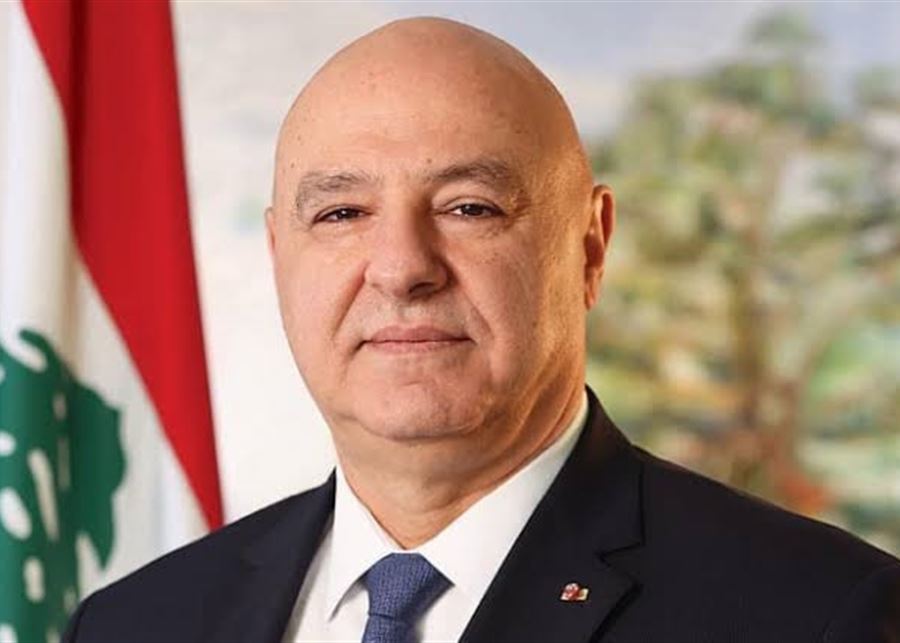
Lebanese President Joseph Aoun said Wednesday, in an interview with Anadolu Agency, that relations between Lebanon and Turkey possess the elements to transition to advanced levels of cooperation, stressing that his country counts on Ankara to contribute to economic recovery, support the implementation of the "framework formula" agreement, and enhance stability in southern Lebanon.
President Aoun explained, ahead of his first official visit to Turkey on Thursday since assuming the presidency, that "Turkey occupies a pivotal position in the current regional landscape, and coordination with him is a strategic necessity, not a circumstantial option."
He considered that Turkey's membership in the North Atlantic Treaty Organization (NATO) and its extensive regional relations qualify it to play a supportive role in international promotion of the "framework formula" and in encouraging the concerned parties to fully commit to its provisions.
He said that "Turkey can contribute to the success of this path, especially since the framework that emerged from the negotiation rounds in Washington and Rome requires broad regional and international follow-up to ensure its implementation on the ground."
Aoun added: "We are committed to implementing what we signed in Washington, but the success of this agreement is contingent upon clear guarantees, most notably a complete and simultaneous Israeli withdrawal alongside the deployment of the Lebanese Army, a definitive halt to the breaches and attacks that continue to target the South, and an effective international mechanism to verify both parties' compliance, so that Lebanese commitments do not turn into a unilateral step in the absence of an Israeli counterpart."
He continued: "We invite Turkey, by virtue of its regional weight and multifaceted relations, to support this path politically and diplomatically, in a manner that enhances its chances of success, prevents it from turning into a incompletely implemented agreement, and contributes to supporting Lebanon's efforts to achieve the Israeli withdrawal and enhancing international efforts aimed at preventing any security vacuum in the South, in line with our keenness on the stability of this sensitive region."
Regarding the role Turkey can play in supporting Lebanon's sovereignty and stability, Aoun said that "Ankara, as an active regional state, possesses real tools of influence, and can contribute to supporting the Lebanese state and its legitimate institutions, foremost among them the army, in a manner that enhances the extension of state authority over all territories."
He added that "Turkey can also employ its relations to contribute to controlling the eastern and northern borders, and preventing any weapons smuggling or infiltration that threatens Lebanese security."
Aoun continued: "We are not asking Turkey for a role alternative to the Lebanese state, but rather a supportive and complementary role, which is in line with our quest to confine arms to the legitimate authorities and stabilize stability after years of war."
He pointed to his country's aspiration to enhance cooperation with Turkey in supporting the institutions of the Lebanese state, particularly the army, and opening new horizons for cooperation in the files of border stability and combating the transfer of illegal weapons.
Related to border stability and combating the transfer of illegal weapons.
In another context, Aoun indicated that Lebanon is counting on Turkey's ability to contribute to the economic recovery path through investment, trade, and reconstruction.
He said that this can be achieved through "encouraging Turkish companies to pump direct investments into Lebanese productive sectors, activating existing trade agreements, and removing logistical obstacles to the exchange of goods, in a manner that eases the burden on the faltering Lebanese economy, and benefiting from extensive Turkish expertise in the field of reconstruction."
Regarding military cooperation between the two countries, President Aoun said that the Lebanese Army needs multifaceted support to enhance its deployment and extend state authority, noting that his country will discuss with Turkey expanding existing military support and training programs.
He said that "the Lebanese Army is fighting an existential challenge in extending state authority over all its territories, and this requires multifaceted support: modern equipment and gear, specialized training, and logistical support that enables it to deploy effectively in sensitive areas, especially in the South, where its deployment is supposed to be accompanied by a complete and simultaneous Israeli withdrawal."
Aoun added: "We will raise with the Turkish side the possibility of expanding the already existing military support and training programs, especially since Ankara has expressed on previous occasions its readiness to contribute to enhancing the capabilities of our military institution. But at the same time, we emphasize that any Turkish support comes in addition to existing American and international support, and not as a substitute for it."
Regarding the possibility of Turkey participating in an international force that might replace the United Nations Interim Force in Lebanon (UNIFIL) in the south of the country, Aoun said that "this file is still under discussion, and there are multiple proposals, some of which speak of a European force under French-Italian leadership, and some of which propose Turkish participation supported by NATO, alongside other proposals that include Arab and Islamic countries."
He added: "For us, the priority is to ensure that no security vacuum occurs after the expiration of UNIFIL's mandate, and any proposal to form an alternative force, including potential Turkish participation, will be viewed from a single angle: its ability to support the Lebanese army in extending its authority and ensuring the stability of the South."
Aoun continued: "We are not about to rule out any serious partner in this path, but the final decision remains linked to a broader international consensus, and to what serves Lebanese sovereignty first."
He pointed out that "Turkey has contributed, through the UNIFIL maritime force, to the peacekeeping process in the South, and this participation was effective in controlling maritime movement towards Lebanon over the past years, in coordination with the Lebanese Army Navy."
Regarding the extent of Hezbollah's rejection of any negotiating path with Israel's impact on the Lebanese state's efforts to complete the implementation of the ceasefire understandings and address outstanding issues, Aoun said: "The size of this challenge cannot be minimized, for any negotiating or executive path needs a minimum of internal consensus to succeed effectively on the ground."
He added: "The Lebanese state, represented by the presidency and the government, is the sole party constitutionally authorized to make decisions related to sovereignty, security, and relations with the outside, and this is what we insist on constantly."
Aoun continued: "In contrast, we realize that the successful implementation of the ceasefire understandings and the addressing of outstanding issues, foremost among them confining arms to the state, requires a cumulative approach and continuous internal dialogue, away from confrontation, so that everyone is convinced that Lebanon's supreme interest lies in a strong state with its legitimate institutions alone, not in the continuation of division over decisions of war and peace."
Regarding what is being circulated about a Syrian role or mediation in the file of confining arms to the Lebanese state, despite Damascus's repeated denials of this, Aoun stressed that the decision is a sovereign Lebanese one and is not subject to any external mediation.
He said that "the decision to confine arms to the Lebanese state is an exclusively sovereign Lebanese decision, made through internal dialogue under the sponsorship of the presidency and legitimate state institutions, and there is no room for any external mediation or intervention in it, whether Syrian or otherwise."
Aoun added: "The Syrian side itself has previously affirmed repeatedly, and at the highest levels, its lack of intention to intervene militarily in Lebanese affairs, and that its support is limited to supporting the principle of confining arms and the decision of war and peace to the Lebanese state, a position we welcome and which aligns with our vision for the sovereignty of the Lebanese decision."
He noted that he affirmed, during his meetings with Syrian President Ahmed al-Sharaa, his keenness that coordination between the two countries be at the level of the political leaderships, based on respect for the sovereignty of each and non-interference in internal affairs.
Aoun continued: "As for what is raised regarding statements or speculations about a broader Syrian role, they are media speculations that do not reflect any negotiating reality or official position, and we are always keen to correct any ambiguity that may arise regarding this sensitive file."
← Previous article
“Free Patriotic” about the electricity plan: Prepared by artificial intelligence
Related Articles
Youssef Rajji: No option to end the Israeli occupation except through negotiation
"He will not be among the ministers of depravity"... A "Lebanese Forces" MP on the Energy Minister: "A man of good upbringing"
Fayad to the Authorities: It Is Time to Acknowledge the Failure of Your Choice