Bassil opens government files: 64 violations of the ministerial statement and more than 50 questions and interrogations
16:59 · 30 September 2026
9 min read
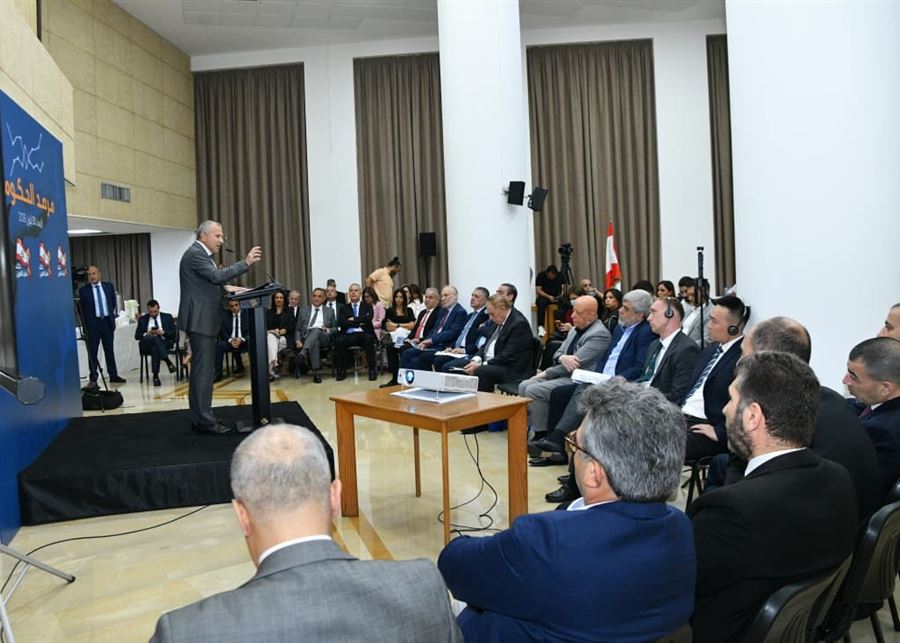
Head of the Free Patriotic Movement, MP Gebran Bassil, renewed his refutation of the government's shortcomings and failure, declaring adherence to the positive and constructive opposition that proposes solutions and alternatives and not the destructive opposition, at the conclusion of the "Government Observatory" organized by the "Strong Lebanon" bloc in the House of Representatives.
Bassil asked: “What did you say and what did you do?” adding: “The Free Patriotic Movement counted 64 violations of the ministerial statement after 19 months of the government’s existence.” He added: “We refuted your words and actions in front of the Lebanese so that they can be the judge, and we have a list of 64 violations of the ministerial statement,” and we propose possible and simple solutions, but which include frankness and disclosure to public opinion about your ability and will.
Port explosion: “They issued a presumptive decision”
Bassil began the ten files with the Beirut port explosion file, asking the government: “What did you say about the port explosion issue? And what did you do other than distort and waste the truth with your politicized and discretionary leaks?” He proposed as an alternative solution “issuing the presumptive decision and approving a law that sets deadlines for the presumptive decisions and rulings.” And in the electricity file, Bassil said: “What did you say about electricity? And what did you do other than empty your pockets? And you put the Lebanese at the mercy and whims of the generator owners because you decided to shut down the factories?
He pointed out that “an additional $185 million annually goes to generators for every hour of electricity that the state does not provide,” adding: “One plan you did not develop, one project you did not implement, and one request you did not reject from the Council of Ministers.”
He stopped at the Minister of Energy’s announcement requesting a reduction of 300,000 liras on gasoline, and said: “Today you have returned to populism, and you are asking the Council of Ministers to reduce 300,000 liras on gasoline, at a time when you set it, and at a time when this is your authority and you can remove it without the Council of Ministers, as we did in those days, but you intend to create a problem in the government in order to say: Leave us alone.”
Bassil proposed what he described as an “easy solution,” calling for “operating the operating factories that we have established, and carrying out the necessary collections without assigning any deficit to the state.” He said: “We have left you a tariff that allows you to purchase fuel to operate the factories without support from the state.”
Water: Complete the implementation of dams
Basil moved to the water file, and asked: “What did you say about water? What did you do other than continue with political maliciousness and not funding the dams despite the presence of a large budget in the ministry, and despite the presence of studies and international scrutiny confirming the correctness of their construction?”
He believed that the solution is to "complete the implementation of dams, because they are the easiest, largest, and cheapest way to supply citizens with water."
Regarding the sovereignty issue, Bassil said: “What did you say about sovereignty? What did you do except become more subservient and sign a framework agreement that gives sovereignty to Israel?” He added that the alternative is to "correct the mistakes in the framework agreement and complete the negotiations, but with the restoration of Lebanon's rights, especially through litigation."
Bassil touched on the file of arms exclusivity, addressing the government by saying: “What did you say about arms exclusivity? What did you do except wait for the war to come and carry out your decision? Do not rely on the outside to limit weapons and the decision is in the hands of the state, and do not give an excuse to those whose excuse becomes that the outside wants to eliminate them.” He proposed as an alternative "to stop betting on the outside and on the war," considering that "force does not disarm. Only the internal path obliges Hezbollah to hand over its weapons and its decision-making power to the state in exchange for reassuring its environment and providing it with all the necessities of life."
Regarding the National Security Strategy, Bassil asked: “What did you say in the National Security Strategy? And what did you do except that you buried it as you buried all your promises?” He called for “preparing a paper and forming a committee with the participation of all forces and placing it on the cabinet table for discussion and approval.”
Regarding the file of displaced Syrians, Bassil accused the government of presenting “false and false numbers,” and said: “You said that 87 percent of them returned, and the result is that statistics confirm the presence of 2.25 million displaced Syrians two years after the end of the war in Syria.” He called on the government to "develop a plan in coordination with the Syrian authorities, as Germany did, and reveal monthly the numbers of returnees, and close the borders to prevent the entry of more displaced people from Syria into Lebanon."
He added: “There is an identity crisis for Lebanon when the number of non-Lebanese residents there becomes more than 45 percent,” considering that “the solution is to confront the crisis, not to ignore it.”
Regarding the file of institutions and administrative reform, Bassil asked: “What did you say about institutions? What did you do with administrative reform other than discretionary appointments and sharing among some of you, and did you make more than one appointment that clearly violated the law?”
He called for "appointing competent people, even if they are from your groups, but according to the law, and removing incompetent people, even if they are from our people," calling at the same time to "stop arbitrariness, imprisonment, and unfair trials, and develop a plan to reform the public sector, even in stages."
Basil addressed the issue of education and said: “What did you say about education? What did you do except close public schools and deprive the children of entire villages of education, and more than that, deprive thousands of students of their certificates and their equivalency on time? The education sector has never witnessed such badness in its history.”
He considered that "the simplest thing is to stop registering displaced Syrians, settle their status later, and give them their certificates, because that reduces the number of Lebanese students," calling for "opening schools to Lebanese students, registering them, and giving them their certificates."
As for the file of depositors’ funds, Bassil asked: “What did you say about returning depositors’ funds? What did you do except that you and the Parliament colluded to not approve the basic law, which is the GAP Law, and did not approve the laws for recovering funds smuggled abroad and looted from the state?”
He criticized the amnesty law, saying that “instead of being satisfied with releasing the oppressed, it acquitted all criminals and guilty parties, especially those who committed major thefts of public funds and depositors’ funds, and acquitted them of corruption crimes.”
He added: "You have not developed a reform plan, nor an economic plan, nor a financial plan. All your concern is to please the banking lobby and exonerate all the perpetrators of financial crimes."
Bassil proposed what he described as a “quick solution,” calling for “the recovery of funds smuggled abroad through trial, accountability, or prosecution, and the adoption of the GAP Law and its implementation, even in stages, to prove the intention to return the funds.” He added: “You have no plans? Go back to the plans we made: the McKinsey plan in economics and the Lazard plan in money, even with modifications.”
At the conclusion of his presentation of the ten files, Bassil said: “We promised you that we would not be like you. When you were participating with us in governance, your concern was to target our success points with the aim of making us fail. Today we are alone in the opposition and you are all in power, but we did not do the same as you.” He added: “We are a constructive opposition that sheds light on your darkness for the benefit of the people and to find solutions in the absence of any proposal from you, but seriously tell us: What did you do? Or what do you intend to do?”
He considered that "the situation is bad, and you can improve it by stopping lying to people and proving that you are serious about developing rescue plans and projects for implementation, and revealing to people where you succeed because of your work and where you fail because of the circumstances."
He called on the government to "stop adopting one policy, which is withdrawing money from people's pockets," and go instead "to where the money is: in operating the economy, in recovering smuggled and stolen funds, in state assets, marine properties, luxuries, and those with high incomes such as generators, oil, and others, instead of enriching them further at the expense of the poor, retirees, and public sector employees."
Bassil stressed that "the ministerial statement is an instrument that the government concludes with the Parliament to obtain confidence," considering that "violating it with 64 items requires accountability, accountability, and interrogation." He added: "We are waiting for the Speaker of the Council to implement his promise to hold an interrogation session to ask our objective and practical questions, which number more than 50, and to wait for their answers, which came to us empty or did not come at all."
Bassil concluded: “When we were in power, we carried out our duties by presenting plans and projects, and when we became in the opposition, we carried out our duties by monitoring, submitting questions and interrogations, and even providing alternative solutions to the non-solutions intended by the government.” He said: “Reform is through plans and projects, not through words and promises. Salvation is through getting rid of the corruption system, not by consolidating it. Governance is a responsibility, not populism.”
In this story:
Gebran Bassil
More from:
Beirut news
← Previous article
For the first time... Kyiv reveals estimates of the annual cost of the war
Related Articles
Al-Tayyar, in response to Al-Moussawi: He is an expert in lying
Hezbollah: We have no connection to the cell allegedly arrested in the Yarmouk Basin area in Daraa
Geagea to Qasim: Your resistance led to the occupation of the south