Weapons, electricity, and salaries... What did MPs say during the Lebanese government accountability session?
12:59 · 16 September 2026
10 min read
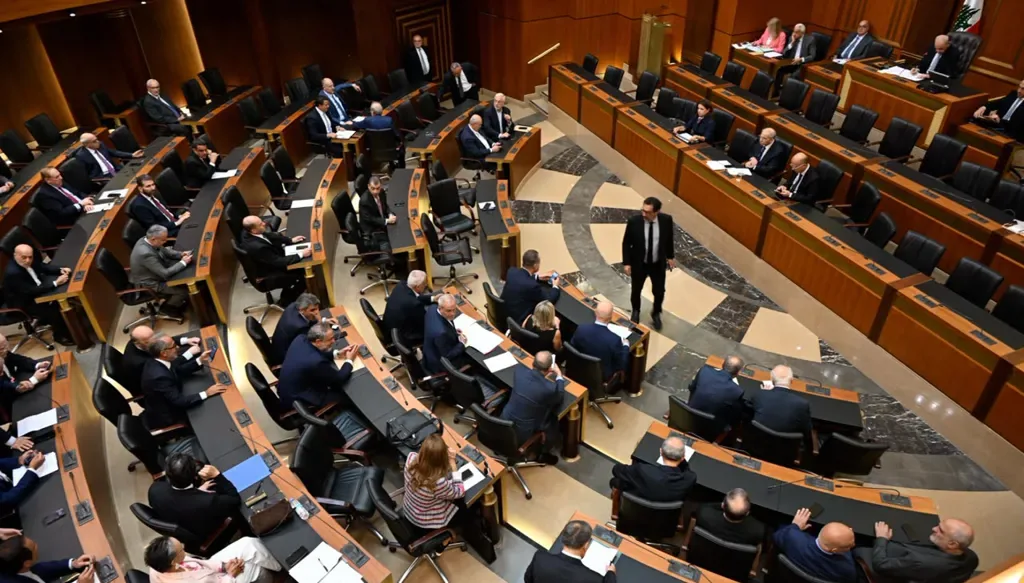
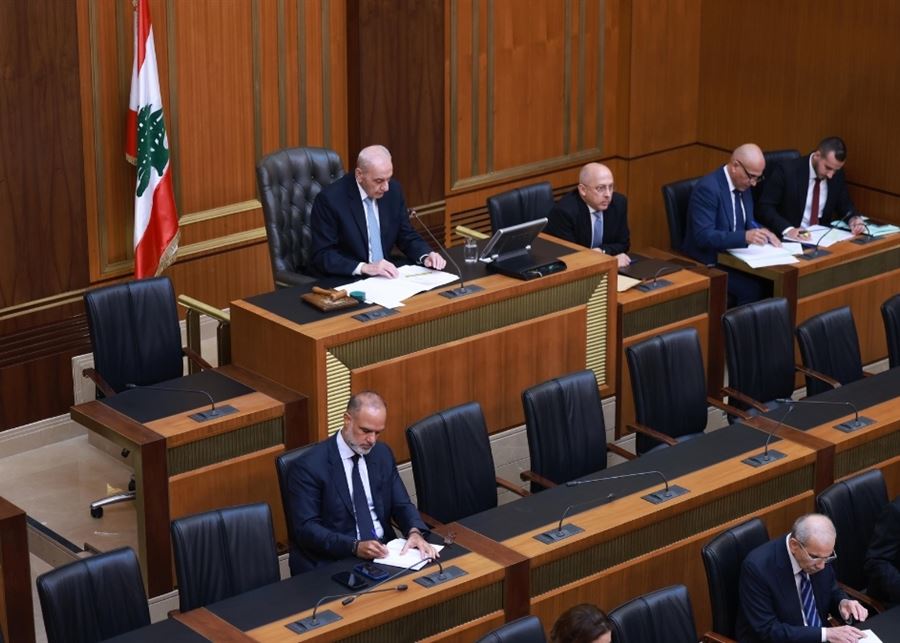
The session of the Lebanese Parliament dedicated to holding the Lebanese government accountable and discussing its work continued on Wednesday, chaired by Parliament Speaker Nabih Berri, amid a parliamentary division over the files of weapons, negotiations, economic reforms, and living conditions.
General amnesty and electricity at the start of the session
MP Marwan Hamadeh called on the Constitutional Council to promptly rule on the appeal regarding the general amnesty law, demanding that prisoners in Roumieh suspend their strike because institutions, as he put it, are bound by a constitutional path that cannot be bypassed.
As for MP Sajih Attieh, he praised the productivity of some ministers, but considered that the government's performance must be better, and that several files need further follow-up, foremost among them electricity, for which he held the government responsible for finding an actual solution.
Yacoubian: Protecting the people is a priority
MP Paula Yacoubian considered that Lebanon's biggest setbacks resulted from straying from the state, bringing other people's wars to its territories, and rebelling against government decisions regarding the monopoly on weapons.
She said that Israeli ambitions are well known, but she questioned the reason for not handing over the remaining unoccupied lands of the south to the Lebanese state.
She stressed that protecting the people must be at the core of the government's work, calling for empowering the Lebanese Army and passing the "positive neutrality of Lebanon" law, alongside implementing administrative decentralization. She also pointed out that the aid Lebanon needs is linked to an agreement with the International Monetary Fund.
El Hout: No taxes in an economy that is not growing
MP Imad El Hout said that the Lebanese citizen needs electricity, and it is impermissible to impose new taxes in an economy that does not achieve growth.
He demanded an integrated plan for Beirut starting from the port, public transport, and infrastructure, all the way to security and making the capital weapons-free.
He also called for the 2027 budget to clarify how to expand the economy and increase investments, stressing the necessity of building a unified sovereign state whose legitimate institutions, foremost among them the Lebanese Army, assume the responsibility of protecting Lebanon.
Mneimneh: Do not burden the government beyond its capacity
MP Ibrahim Mneimneh considered that citizens support the government in its path to restore the state, but that does not mean burdening it beyond its capacity.
He said that officials must go down to the street and listen to the concerns of citizens, affirming adherence to the government out of adherence to institutions and the cause of restoring the state.
Boustani and Alain Aoun: The priority is for economy and investment
MP Farid Boustani affirmed that the citizen does not measure the government's success by the number of its sessions, but rather by the extent of the improvement in their life and public services.
He believed that the budget must reflect the state's vision, and be based on realistic figures and a clear economic plan that supports productive sectors, warning that the country cannot bear new taxes, and calling for addressing tax evasion.
For his part, MP Alain Aoun called for thinking seriously about improving the conditions of citizens, and not waiting for external solutions after the war changed the existing equations.
He demanded creating conditions to attract private funding and investments, and heading towards fragmenting investments in the electricity sector to facilitate the entry of the private sector.
Weapons and the framework agreement
MP Melhem Khalaf rejected the decision to go to war, but questioned in return the "good faith" stipulated in the framework agreement, in light of the ongoing Israeli destruction in southern Lebanon.
MP Simon Abi Ramia affirmed the necessity of completing the path of reform, stressing that citizens want to recover their money, that sovereignty is indivisible, and that the state and the people are the ones who defend Lebanon's interest.
For his part, MP Melhem Riachy described the monopoly on weapons as a "foundational issue," affirming that disarming must take place within the framework of the law and the state, and calling on the government to discuss the principle of neutrality seriously to protect Lebanon.
MP Pierre Bou Assi believed that the continuation of the war and the non-implementation of the decisions on the monopoly on weapons will prevent investments and put the government and the country in a vicious circle.
As for MP Antoine Habchi, he pointed out that the framework agreement contributed to the recovery of five Lebanese prisoners from Israel, considering that handing over the Ali Al-Tanter facilities to the Lebanese Army would have strengthened the Lebanese negotiator's position and prevented them from falling into Israeli hands. He also called for stopping the alteration of landmarks in the south and abandoning arrogance.
Abdel Massih: Confidence in the government and criticism of administration
MP Adib Abdel Massih affirmed the existence of confidence in the government, but criticized the management mechanism and some appointments.
He called for granting citizens loans to install solar energy systems instead of imposing taxes on them, demanding a reconsideration of living conditions and salaries.
In statements to "An-Nahar" from Parliament, MPs Ashraf Rifi and Pierre Bou Assi focused on the necessity of accelerating the implementation of the ministerial statement, particularly regarding the monopoly on weapons in the hands of the state, alongside protecting limited-income earners and finding solutions to the electricity crisis.
Rifi: Do not lose your supporting environment
MP Ashraf Rifi called on the government to take into consideration the conditions of employees, workers, and limited-income earners, warning that stressful financial measures might lead to it losing its "supporting environment."
Rifi told "An-Nahar" that he is not accusing the government of falling short, but rather is keen to alert it to the potential social repercussions of some of its decisions.
He added: "The government might try to achieve a balance between expenditures and revenues, which is a natural right in principle, but the timing is inappropriate because people are no longer able to bear it."
He addressed Prime Minister Nawaf Salam, saying: "Your Excellency the Prime Minister, do not lose your supporting environment. This environment is the employees, workers, and limited-income earners. If you pressure them too much, they will eventually turn against the government."
Regarding the implementation of the ministerial statement, Rifi considered that "there is no ambiguity about the political proposal," but demanded faster and firmer implementation, especially in the file of the monopoly on weapons.
He said: "The state must not fear Hezbollah or any armed faction. Legitimacy belongs to the state and not to Hezbollah."
Bou Assi: No investments in the shadow of weapons and war
For his part, MP Pierre Bou Assi affirmed to "An-Nahar" that achieving strategic solutions to Lebanon's crises, foremost among them electricity, remains impossible in the absence of stability and the continuation of weapons outside the state's authority.
He said that the Ministry of Energy remained for years under the administration of the Free Patriotic Movement and its head, MP Gebran Bassil, without reaching a solution to the electricity crisis despite the availability of time and money.
He added: "There was time and money throughout 12 years, and nothing was accomplished. As for today, time is tight and the state does not have money."
He believed that addressing the electricity crisis requires involving the private sector, but the investor needs stability and guarantees, saying: "The private sector is not a Caritas institution. It wants to invest and make a profit, but it needs stability."
Bou Assi affirmed that his party bears responsibility for the performance of its ministers, positively and negatively, but criticized the absence of seriousness in implementing government decisions, especially those related to state sovereignty and the monopoly on weapons.
He added: "We say we want sovereignty and the disarmament of Hezbollah, but the facts on the ground do not change. This is one of the reasons for the absence of stability, prosperity, and investments from Lebanon."
He stressed that the task of the Lebanese Army is to impose state sovereignty over its entire territory, saying: "We want the exclusivity of weapons in the hands of the Lebanese Army; there is no successful state in the world that includes two states within its territory."
Prime Minister Nawaf Salam had announced, at the beginning of the discussion session, that his government stands before Parliament to present what it has achieved and what it is committed to accomplishing, pointing out that the cost of the two wars on Lebanon exceeded $20 billion, and may surpass $27 billion after the calculation of the cost of the 2026 war is completed.
Hawat: The government took fundamental national decisions
For his part, MP Ziad Hawat affirmed to "An-Nahar" that no one can be completely satisfied with the government's performance, pointing to the possibility of a shortcoming in the work of some ministries.
He said: "No one is 100 percent satisfied with the government's performance as a whole, but we are satisfied with its taking, for the first time, essential and fundamental national decisions that restored the state's prestige and position."
He added that the importance of this government lies in its ministerial statement affirming the necessity of extending state authority over the entire Lebanese territory and the monopoly on weapons in its hands.
He continued: "For the first time, the ministerial statement stipulates that the Lebanese authority extends its sovereignty over the entire 10,452 square kilometers, and that it has no partner in carrying weapons on Lebanese territory."
Hawat concluded: "These are major decisions that can be built upon in order to establish a new Lebanon."
Kanaan: Lebanon must negotiate for itself and I rejected the framework agreement
For her part, MP Halime El Kakour affirmed that "Iran is forbidden from negotiating for Lebanon, and Lebanon is the one that negotiates for itself."
Attacking the "framework agreement," she said: "Shame on such an agreement; you ruined in the negotiations everything that came in the ministerial statement and the oath of office, and you should have adhered to the statement and the oath before going to negotiations."
She added: "We are all Shia when a Shia is struck," considering that the stance on the agreement must not prevent adherence to the exclusivity of weapons and the state's decision.
Hassabani: The question is not what the government decided, but what it implemented
MP Ghassan Hasbani also affirmed that the government "took historical decisions to monopolize weapons in the hands of the state," stressing that "the question today is not what you decided, but what you implemented?"
He pointed out that the implementation of the decisions on the monopoly on weapons "is not limited to the military aspect," addressing the government by saying: "What has been achieved in controlling the borders and crossings, and preventing the entry and storage of weapons? And where has the Military Court reached?"
Source
النهار
← Previous article
Aoun to AFP: We seek a security agreement that ends hostility with Israel