Economy
01:20 PM | 06 May 2026
Statement from the Bank of Lebanon... What was revealed about the increase in assets in foreign currencies?
Fady Mahouly
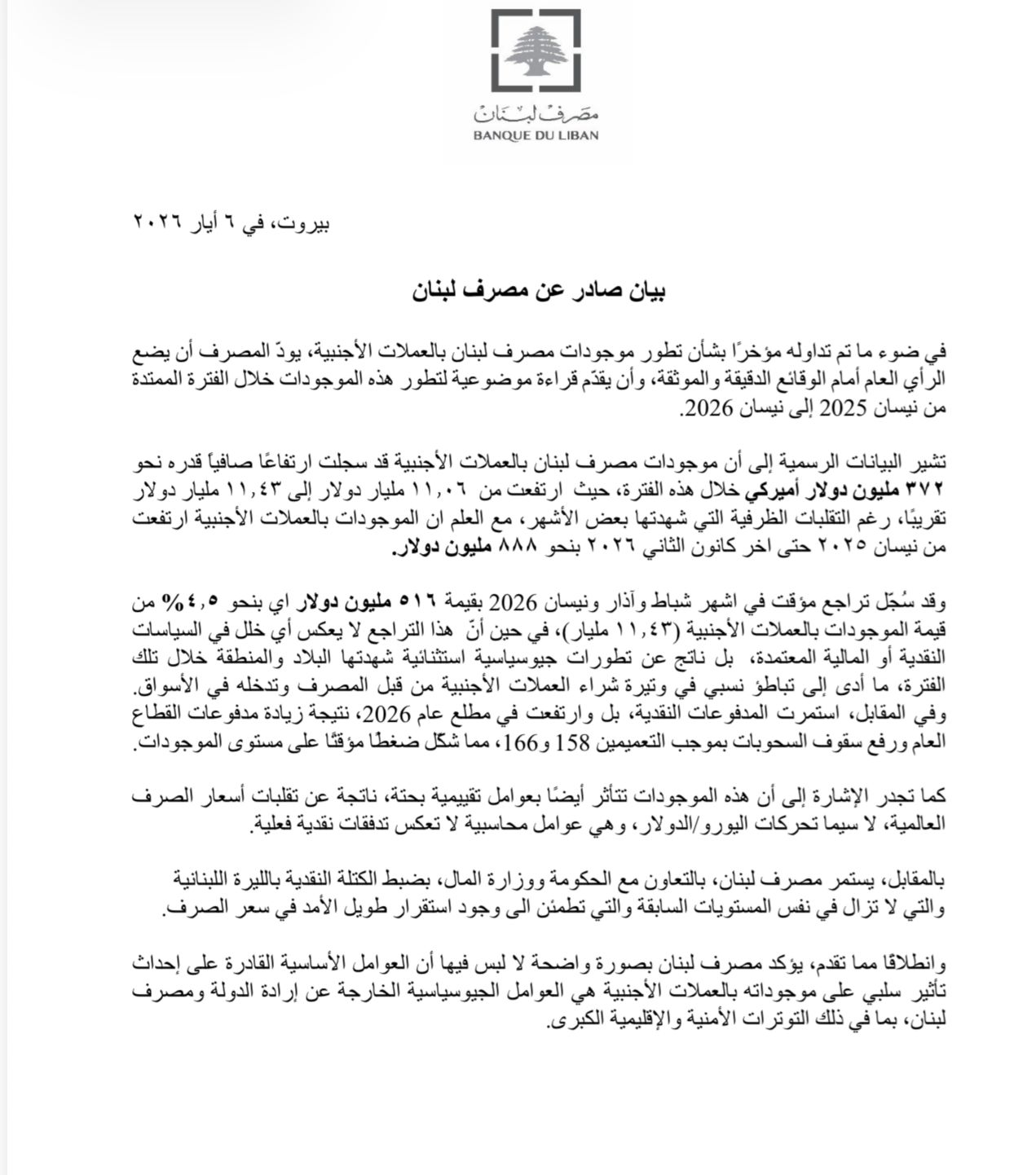
The Bank of Lebanon announced in a statement that, in light of what was recently circulated regarding the development of the Bank of Lebanon’s assets in foreign currencies, the Bank would like to put public opinion before the accurate and documented facts, and to provide an objective reading of the development of these assets during the period extending from April 2025 to April 2026.
He stated in a statement that official data indicate that the assets of the Bank of Lebanon in foreign currencies recorded a net increase of about 372 million US dollars during this period, rising from 11.06 billion dollars to approximately 11.43 billion dollars, despite the circumstantial fluctuations witnessed in some months, knowing that assets in foreign currencies increased from April 2020 until the end of January 2026 by about 888 million dollars.
The Bank of Lebanon said: “A temporary decline was recorded in the months of February, March and April 2026, amounting to $516 million, or about 4.5% of the value of assets in foreign currencies (11.43 billion), while this decline does not reflect any defect in the approved monetary or financial policies, but rather results from exceptional geopolitical developments that the country and the region witnessed during that period, which led to a relative slowdown in the pace of purchases of foreign currencies by the Bank and its intervention in the markets. On the other hand, cash payments continued, and even It rose at the beginning of 2026, as a result of the increase in public sector payments and the raising of withdrawal ceilings in accordance with Circulars 158 and 166, which put temporary pressure on the level of assets.
He pointed out that these assets are also affected by purely evaluative factors, resulting from fluctuations in global exchange rates, especially the movements of the euro and the dollar, which are accounting factors that do not reflect actual cash flows.
The statement said: “On the other hand, the Bank of Lebanon, in cooperation with the government and the Ministry of Finance, continues to control the monetary supply in the Lebanese pound, which remains at the same previous levels, which reassures that there is long-term stability in the exchange rate.”
Based on the above, the Bank of Lebanon has clearly and unambiguously confirmed that the main factors capable of causing a negative impact on its assets in foreign currencies are geopolitical factors beyond the control of the state and the Bank of Lebanon, including major security and regional tensions.
The Bank of Lebanon said in its statement: “As for the monetary policies adopted by the Central Bank, as well as the state’s financial policies followed by the Ministry of Finance, they have proven their ability to maintain a relative balance in the market and to protect assets, despite the scarcity of resources and exceptional circumstances. Therefore, linking any circumstantial decline in these assets to internal decisions is a link that is contrary to the facts.”
The Bank of Lebanon affirmed its continued management of these assets with the highest levels of caution and responsibility, ensuring the protection of monetary stability and the interests of depositors and the national economy.
Media